Proof of Useful Inference vs Proof of Useful Work : FLOP, Flux, Gonka et Bittensor
Ce que signifie la Proof of Useful Inference, pourquoi vérifier l'inférence IA est difficile, et comment FLOP, Flux PoUW v2, Gonka et Bittensor s'y prennent. (Article en anglais)
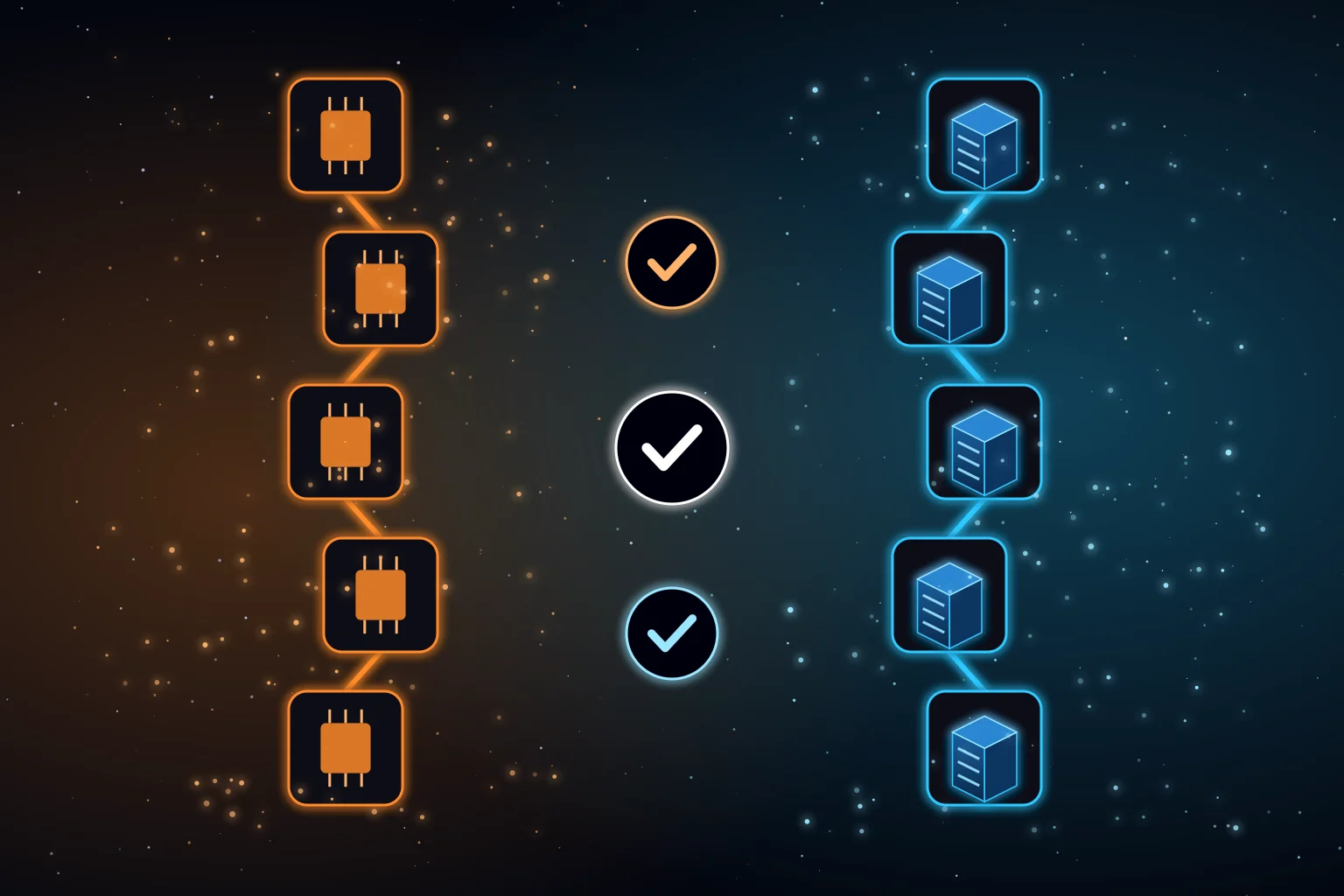
Proof of Useful Inference vs Proof of Useful Work: FLOP, Flux, Gonka and Bittensor
Arthur Hayes' FLOP Network made "Proof of Useful Inference" a hot keyword. Flux has used "Proof of Useful Work" for years. Same idea? Not quite. A plain-language explainer, part of our FLOP series: FLOP Network vs Flux (RunOnFlux).
The problem every "useful work" chain must solve
Bitcoin mining wastes computation on purpose, and that is not a bug. A hash puzzle is very expensive to solve and almost free to check: anyone can verify a block in a fraction of a second. That asymmetry is what makes proof of work secure.
Useful work breaks the asymmetry. Checking that a GPU really ran a large language model on a given prompt, with the right weights, can cost almost as much as running it again. Every "useful work" design is therefore a trade-off between how useful the work is and how cheaply it can be verified. The four projects below made four different choices.
Flux: Proof of Useful Work v2 (hosting, secured by collateral)
Flux started as a GPU-mined chain. In October 2025 it soft-forked to PoUW v2 and took GPUs out of consensus entirely. Blocks are now produced by FluxNodes (Cumulus, Nimbus, Stratus) that lock FLUX as collateral, pass hardware benchmarks and host real containerized applications. Bad behavior gets a node removed from the reward list. The "useful work" is hosting; the security comes from collateral and redundancy, not from proving each computation. Block time dropped from 2 minutes to 30 seconds, and rewards became a fixed 14 FLUX per block (12.6 FLUX since block 3,071,200, late October 2026). Details: the PoUW v2 fork analysis.
FLOP: Proof of Useful Inference (inference, secured by proofs and stake)
FLOP takes the opposite road and puts GPU inference at the center. AI agents post paid inference requests; miners run them and submit proofs; validators include the proof hashes in one-second blocks. To make verification affordable, FLOP layers three techniques:
- •TOPLOC activation fingerprints: compact signatures of the model's internal activations that are hard to fake without running the model.
- •Randomized re-execution: a sample of sessions is re-run and compared. Because miners stake FLOP and can be slashed up to their full stake, cheating becomes a losing bet.
- •Optional trusted hardware: a "HARD" tier using NVIDIA Confidential Computing on TDX or SEV-SNP hosts, for confidential sessions.
Gonka and Bittensor, the two closest neighbors
Gonka is a layer 1 built on a transformer-based proof of work, designed to direct almost all available GPU power to AI workloads, mostly inference. Bittensor produces blocks with standard Substrate consensus; its "intelligence" layer lives in subnets where validators score miners' model outputs and rewards follow those scores.
Side-by-side comparison
| Flux (PoUW v2) | FLOP (PoUI) | Gonka | Bittensor | |
|---|---|---|---|---|
| Useful work | Hosting applications | Paid AI inference for agents | AI inference (training planned) | Model outputs in subnets |
| GPUs in consensus | No (since Oct 2025) | Yes | Yes | No (subnet layer) |
| How honesty is enforced | Collateral, benchmarks, redundancy | Fingerprints, re-execution, stake, optional TEE | Transformer-based PoW | Validator scoring |
| Who pays | App owners | AI agents | Inference users | Emissions + subnet users |
| Status (Nov 2026) | Mainnet since 2018 | Public testnet | Mainnet | Mainnet |
So which approach is right?
Probably several. Flux chose robustness: consensus stays cheap and simple, and the useful work is sold as a cloud service. FLOP chose ambition: if inference can be verified cheaply at scale, every second of GPU work secures the chain and creates a market price for compute. The two are not exclusive, which is precisely the argument of our open letter to Arthur Hayes.
FAQ
What is Proof of Useful Inference?
Proof of Useful Inference (PoUI) is the consensus model of FLOP Network: miners earn rewards by running AI inference requested and paid for by agents, then submitting a proof that validators record on-chain.
What is the difference between Proof of Useful Work and Proof of Useful Inference?
Proof of Useful Work is the general family: any consensus where the effort securing the network also produces something useful. Proof of Useful Inference is one member of that family, where the useful work is specifically AI inference. Flux uses the name PoUW v2 for a node-based model where the useful work is hosting applications.
Why did Flux stop GPU mining?
In October 2025, Flux soft-forked to PoUW v2 and moved block production to collateralized FluxNodes. Blocks went from 2 minutes to 30 seconds, mining pools disappeared and node rewards became predictable.
How does FLOP verify that inference was really done?
FLOP combines TOPLOC activation fingerprints, randomized re-execution of sessions and, in an optional tier, trusted execution environments based on NVIDIA Confidential Computing.
Is FLOP the same as Gonka or Bittensor?
No. Gonka uses a transformer-based proof of work aimed at directing GPU power to inference. In Bittensor, block production relies on standard Substrate consensus while subnets reward miners for model outputs. FLOP settles paid inference sessions between agents and miners and plans a compute price index on top.
Related: How to mine FLOP · AI agents on FLOP and Flux · FLOP vs Flux.
Sources & Further Reading
Autres articles qui pourraient vous intéresser
FLOP Network vs Flux : lettre ouverte à Arthur Hayes sur la Proof of Useful Inference
Le FLOP Network d'Arthur Hayes (Flop Labs) vient d'ouvrir son testnet. Comparaison avec Flux (RunOnFlux) : similitudes, différences, leçons de FluxEdge, et pourquoi les deux équipes devraient se parler. (Article en anglais)
Cloud décentralisé Flux : le guide complet du DePIN (2026)
Guide complet de Flux — le 'AWS du Web3'. Solution Advisor du NVIDIA Partner Network, PoUW v2, marketplace GPU FluxEdge, tokenomics, analyse d'investissement et vue d'ensemble de l'écosystème.
Agents IA : héberger sur Flux, acheter l'inférence sur FLOP
Plus de 200 agents IA tournent déjà sur Flux. FLOP veut leur vendre de l'inférence. Comment hébergement et inférence décentralisés s'articulent. (Article en anglais)
Ce qui tourne sur Flux : nous avons compté tout le registre
Nous avons récupéré chaque spécification d'application du réseau Flux et compté. Les serveurs de jeu font 57,8 % des déploiements, un seul titre en fait 30 %, et 54 % des spécifications sont désormais chiffrées — personne lisant l'API publique ne peut donc énoncer l'utilisation du réseau. Méthode incluse.
Flux en 2026 : PoUW v2, réduction annuelle et date du PNR
Onze mois d'actualité de la chaîne Flux en un seul endroit : les blocs de 30 secondes et la récompense de 14 FLUX, la première réduction annuelle de -10 % au bloc 3 071 200, les huit chaînes parallèles retirées avec une date de forclusion, et l'activation de PNR le 1er juillet 2027. Chaque chiffre avec sa hauteur de bloc.