Agents IA : héberger sur Flux, acheter l'inférence sur FLOP
Plus de 200 agents IA tournent déjà sur Flux. FLOP veut leur vendre de l'inférence. Comment hébergement et inférence décentralisés s'articulent. (Article en anglais)
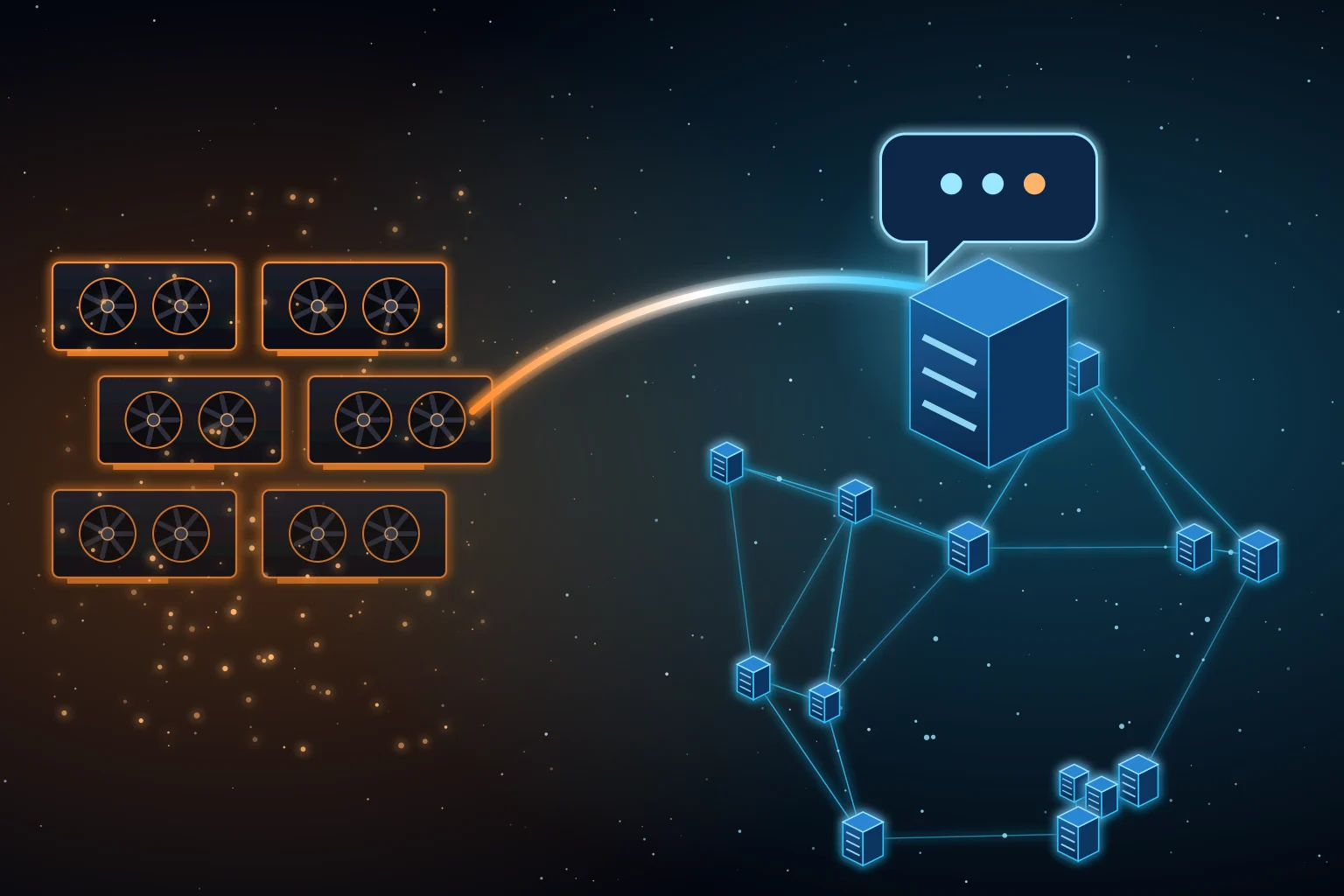
AI Agents Need a Home and Food: Flux Hosting Meets FLOP Inference
Arthur Hayes calls FLOP "food for your AI agent". But an agent also needs somewhere to live. Part of our FLOP series: FLOP Network vs Flux (RunOnFlux).
An agent has two needs: a place to run, and compute to think
A personal AI agent is two things at once. A small program that is always on (it listens to your messages, keeps memory, holds credentials, runs tools), and a big consumer of inference every time it has to reason. Today, most agents solve the first need on a VPS or a laptop and the second with a centralized API key. Decentralized infrastructure can now cover both, with two different networks.
Where agents live: more than 200 already run on Flux
The Flux census of November 2026 counts more than 200 personal AI agents deployed on FluxCloud: 179 OpenClaw instances (private assistants connected to Telegram, WhatsApp or Discord, each using its owner's own AI key) and 31 Hermes agents. They benefit from what FluxCloud does for every application:
- •Redundancy: each app is scheduled on several independent nodes, so an agent does not die with one machine.
- •Privacy: 58% of Flux applications are now private deployments whose code, configuration and secrets are encrypted so that only ArcaneOS nodes can run them. Agents hold API keys and personal data: this matters.
- •No single provider: 6,912 independently operated nodes, no hyperscaler account to be suspended.
Want to try? Our guide OpenClaw on Flux walks through a deployment.
Where agents could eat: FLOP's inference market
FLOP Network is designed around agents as paying customers. An agent posts an inference request (model, latency, compute, confidentiality, fee), a miner runs it and proves it, and the agent pays in FLOP. During the testnet, agents get daily test coins, and the compute they buy in settled sessions earns them a share of a 1.2 billion FLOP airdrop pool, locked for buying inference. The pitch: instead of a credit card behind an API key, an agent holds a currency that converts directly into compute.
The natural architecture: live on Flux, eat on FLOP
| Need of the agent | Centralized today | Decentralized option |
|---|---|---|
| Always-on runtime, memory, credentials | VPS, laptop, hyperscaler | FluxCloud (redundant, private deployments) |
| Inference | API key billed by card | FLOP sessions paid in FLOP (testnet) |
| Identity and payments | Accounts and cards | DID + wallet (FLOP) |
To be clear: no integration between Flux and FLOP exists today, and we have not tested an OpenClaw agent buying inference on the FLOP testnet. This is an architecture that both networks make possible, and one more reason why the two teams should talk.
The full argument, the similarities and differences between the two projects, and who to contact are in our pillar article: Hey Arthur Hayes, meet Flux.
FAQ
How many AI agents run on Flux?
More than 200 personal AI agents according to the Flux census of November 2026: 179 OpenClaw deployments and 31 Hermes agents.
How do AI agents participate in the FLOP testnet?
An agent needs a decentralized identifier (DID) and a wallet. It receives test coins daily to buy inference, and its share of the 1.2 billion FLOP agent airdrop is based on the compute it bought in settled sessions. That allocation is locked and can only be spent on inference.
Can an agent hosted on Flux pay for inference with FLOP?
Technically nothing prevents an agent running on FluxCloud from calling FLOP through its SDK, as it would call any API. No official integration exists between Flux and FLOP today.
Why host an AI agent on Flux rather than on a single server?
FluxCloud schedules each application on several independent nodes, so the agent survives a machine failure, and private deployments are encrypted so that only ArcaneOS nodes can run them.
Related: How to mine FLOP · Proof of Useful Inference explained.
Autres articles qui pourraient vous intéresser
FLOP Network vs Flux : lettre ouverte à Arthur Hayes sur la Proof of Useful Inference
Le FLOP Network d'Arthur Hayes (Flop Labs) vient d'ouvrir son testnet. Comparaison avec Flux (RunOnFlux) : similitudes, différences, leçons de FluxEdge, et pourquoi les deux équipes devraient se parler. (Article en anglais)
Miner du FLOP : GPU requis, testnet et airdrop (guide 2026)
Miner du FLOP sur le réseau d'Arthur Hayes : 16 Go de VRAM, résultats RTX 5080, récompenses, répartition de l'airdrop de 3,6 milliards, calendrier et sécurité. (Article en anglais)
Ce qui tourne sur Flux : nous avons compté tout le registre
Nous avons récupéré chaque spécification d'application du réseau Flux et compté. Les serveurs de jeu font 57,8 % des déploiements, un seul titre en fait 30 %, et 54 % des spécifications sont désormais chiffrées — personne lisant l'API publique ne peut donc énoncer l'utilisation du réseau. Méthode incluse.
Flux en 2026 : PoUW v2, réduction annuelle et date du PNR
Onze mois d'actualité de la chaîne Flux en un seul endroit : les blocs de 30 secondes et la récompense de 14 FLUX, la première réduction annuelle de -10 % au bloc 3 071 200, les huit chaînes parallèles retirées avec une date de forclusion, et l'activation de PNR le 1er juillet 2027. Chaque chiffre avec sa hauteur de bloc.
Cloud décentralisé Flux : le guide complet du DePIN (2026)
Guide complet de Flux — le 'AWS du Web3'. Solution Advisor du NVIDIA Partner Network, PoUW v2, marketplace GPU FluxEdge, tokenomics, analyse d'investissement et vue d'ensemble de l'écosystème.
Écosystème Flux : la carte de tous les produits et entités
Document de recherche exhaustif de niveau institutionnel avec sources primaires vérifiées. Tous les partenariats stratégiques, produits, tokenomics, études de cas, gouvernance, compliance, roadmap et 100+ sources référencées.