Zelcore & SSP Wallet: Redefining Multi-Chain Self-Custody
The complete Flux wallet ecosystem: Zelcore (700K+ users, 80+ chains, d2FA), SSP Wallet (2-of-2 multisig, ERC-4337 Account Abstraction), and the Fusion cross-chain bridge.
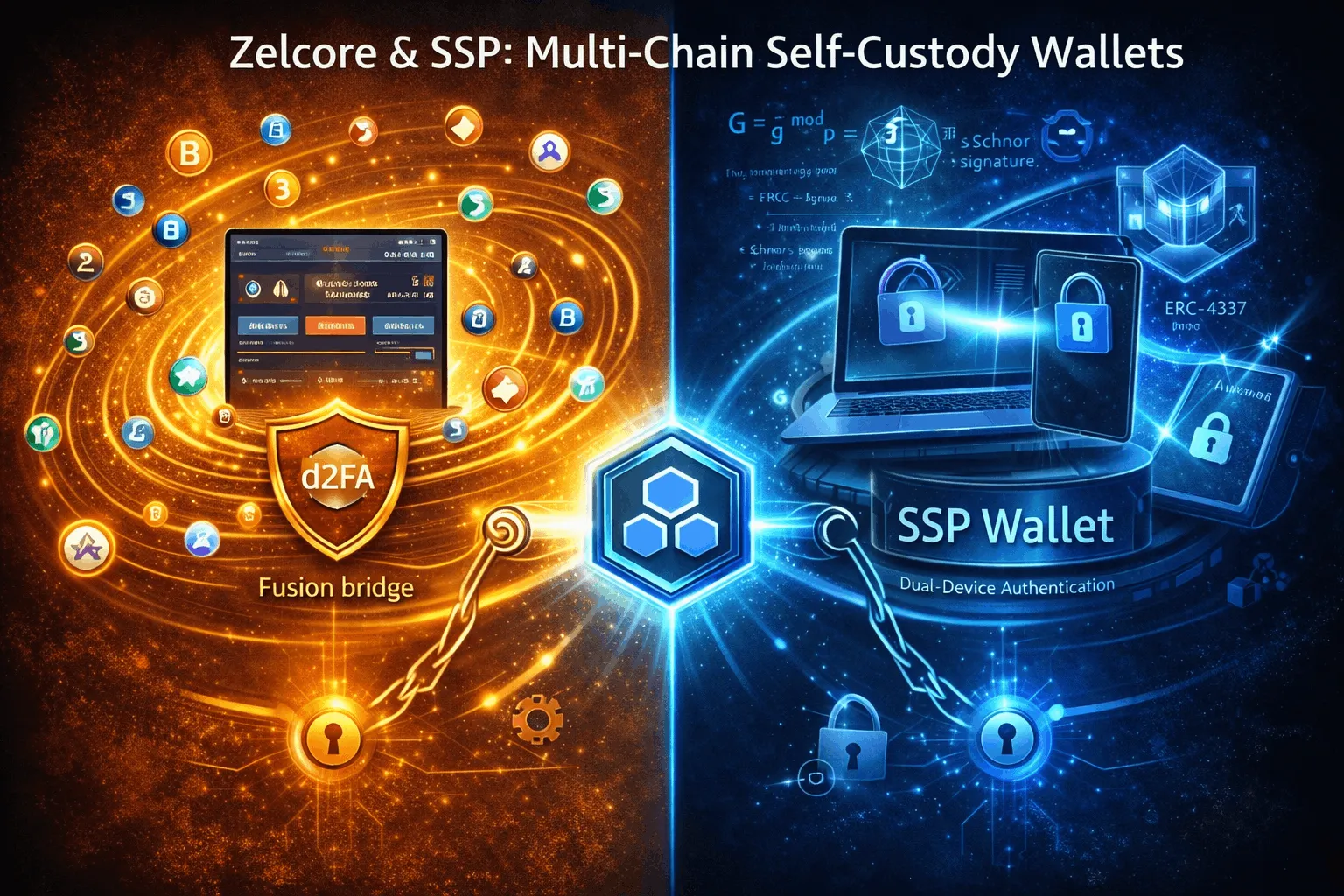
Zelcore and SSP Wallet: The Flux Wallet Ecosystem Redefining Multi-Chain Self-Custody
How InFlux Technologies builds a complete wallet infrastructure for the decentralized Web3.
In an industry where "not your keys, not your coins" remains a foundational principle, the Flux ecosystem has constructed one of the most ambitious wallet infrastructures in Web3. From Zelcore's multi-chain versatility to SSP Wallet's enterprise-grade multisig security, InFlux Technologies is building a comprehensive self-custody stack that bridges the gap between retail simplicity and institutional rigor. This article provides a complete technical and strategic analysis of the Flux wallet ecosystem.
Part 1: Actors of the Flux Wallet Ecosystem
InFlux Technologies: The Strategic Acquirer
In November 2023, InFlux Technologies completed the strategic acquisition of Zelcore, bringing the multi-chain wallet under the Flux ecosystem's umbrella. This move consolidated wallet infrastructure as a core pillar of the Flux stack.
"The acquisition of Zelcore is not just about adding a wallet to our portfolio. It is about building a complete self-custody infrastructure that aligns with our vision of a decentralized internet. Wallets are the gateway to Web3, and we intend to make that gateway as secure and accessible as possible." — Daniel Keller, Flux co-founder.
InFlux Technologies is headquartered in Cambridge, United Kingdom and operates the Flux network — a decentralized cloud infrastructure comprising 8,000+ active nodes across 67 countries. The wallet acquisition reflects InFlux's strategy of vertical integration: owning not just the compute layer, but also the user-facing tools that interact with it.
Zelcore Technologies: From Independent to Integration
Prior to the acquisition, Zelcore had established itself as one of the most versatile multi-chain wallets in the ecosystem:
- •700,000+ registered users globally
- •2.5 million addresses generated across all supported chains
- •1 million+ blockchain assets trackable within the interface
- •80+ blockchain protocols supported natively
- •500+ cryptocurrencies with direct wallet support
The Zelcore team, based in Portland, Oregon, pioneered several innovations that remain central to the wallet's identity. In 2018, they introduced d2FA (decentralized two-factor authentication), a groundbreaking on-chain security mechanism. In 2021, they launched the Fusion Bridge within Zelcore, enabling seamless parallel asset swaps directly from the wallet interface.
SSP Wallet: The Enterprise-Grade Answer
While Zelcore serves the retail and power-user segment, SSP Wallet (Secure Simple Paired) was developed to address the enterprise and high-security market. Unveiled in October 2023 and entering beta in January 2024, SSP Wallet introduces a multisig 2-of-2 architecture that requires two separate devices to authorize any transaction.
SSP Wallet represents a philosophical shift: rather than securing a single device with passwords and 2FA, it distributes the signing authority across two independent devices, ensuring that the compromise of any single device cannot result in loss of funds.
Competitive Landscape
| Wallet | Estimated Users | Category |
|---|---|---|
| MetaMask | 143 million | Browser Extension / Mobile |
| Trust Wallet | 115 million | Mobile Multi-chain |
| Coinbase Wallet | 70 million | Exchange-integrated |
| Ledger Live | 18 million | Hardware Wallet Interface |
| Zelcore | 700,000+ | Multi-chain Desktop / Mobile |
| SSP Wallet | New (beta) | Enterprise Multisig |
While Zelcore's user base is modest compared to the giants, its depth of multi-chain support (80+ protocols) and unique features (d2FA, Fusion integration) position it as a specialized tool for power users rather than a mass-market competitor to MetaMask or Trust Wallet.
Part 2: Technical Architecture and Innovations
Zelcore: Multi-Chain Architecture
Zelcore's key innovation lies in its unique key generation mechanism. Unlike most wallets that rely on BIP-39 seed phrases, Zelcore derives keys from a combination of username + password:
- 1
Username Input
The user provides a unique username (not stored on any server).
- 2
Password Input
A strong password is combined with the username.
- 3
Double-Hash Derivation
The combination is processed through a double-hash function (hash of the hash), producing a master key from which all blockchain-specific keys are deterministically derived.
"The Zel ID system uses a double-hash derivation process where the combination of username and password generates a unique master key. This approach eliminates the need for seed phrase backup while maintaining full deterministic key generation across all supported blockchains." — Zelcore Technical Documentation.
This means that a user can restore their entire multi-chain wallet on any device simply by remembering their username and password — no seed phrase required. While this shifts the security model (the strength of the password becomes critical), it dramatically simplifies the user experience for managing 80+ blockchain protocols from a single interface.
d2FA: Decentralized Two-Factor Authentication
Introduced in 2018, Zelcore's d2FA (decentralized 2FA) is one of its most distinctive security features. Unlike traditional 2FA that relies on centralized services (Google Authenticator, Authy, SMS), d2FA stores the authentication data on-chain.
The mechanism works as follows: users set an encrypted PIN of 4 to 10 digits, which is stored on the Flux blockchain. Each d2FA registration costs approximately ~0.0002 FLUX, making it economically negligible while providing a permanent, decentralized authentication layer.
"d2FA eliminates the single point of failure inherent in centralized 2FA solutions. By storing the authentication PIN encrypted on-chain, we ensure that no server compromise can disable your second factor." — Zelcore Documentation.
The key advantage: if Zelcore's servers go down or the company ceases operations, the d2FA data persists on the Flux blockchain, ensuring users retain access to their second authentication factor indefinitely.
Anti-Keylogger Protection
In 2022, Zelcore introduced a randomized virtual numpad for PIN entry. This feature protects against keylogger attacks by ensuring that the physical key positions change with every use. Even if a keylogger records the exact screen coordinates of each tap, the captured data is useless because the number positions are randomized for each session.
Multi-Chain Support
Zelcore's breadth of support is among the widest in the wallet ecosystem:
- •80+ blockchain protocols supported natively (not just EVM chains)
- •500+ cryptocurrencies with direct wallet management
- •100,000+ tokens trackable across all chains
- •WalletConnect v2 integration for dApp connectivity
- •Ledger and Trezor hardware wallet support for cold storage pairing
- •18 languages supported in the interface
This multi-chain depth is particularly valuable for the Flux ecosystem, where parallel assets exist across 10+ different blockchains. Zelcore serves as the native wallet for managing all Flux parallel assets from a single interface.
Fusion Bridge Integration
The Fusion Bridge is integrated directly into Zelcore, enabling users to swap between Flux parallel assets without leaving the wallet interface:
- •1:1 swaps between native FLUX and all 10 parallel assets
- •Supported parallel assets: Flux-KDA, Flux-ETH, Flux-BSC, Flux-SOL, Flux-TRX, Flux-AVAX, Flux-ERGO, Flux-ALGO, Flux-BTC, and soon Flux-Ink
- •Liquidity pools maintained for each trading pair
- •Full liquidity guarantee: Every parallel asset is backed 1:1 by locked FLUX on the main chain
"Fusion operates with full liquidity — meaning every parallel asset in circulation is backed by an equivalent amount of FLUX locked on the native chain. This ensures instant, guaranteed 1:1 swaps at all times." — Fusion Bridge Documentation.
SSP Wallet: Multisig 2-of-2 Architecture
SSP Wallet's core innovation is its dual-device multisig architecture. Unlike traditional wallets where a single device holds full signing authority, SSP splits it across two devices:
- •Device 1: Browser Extension — Acts as the primary interface for initiating transactions
- •Device 2: Mobile App — Acts as the co-signer, required to approve every transaction
- •SSP Relay Server: Facilitates communication between the two devices (non-custodial; relays encrypted data only)
- •QR Code Pairing: Initial device pairing is performed via QR code scanning for secure setup
The sync process follows three steps:
- 1
Key Generation
Each device generates its own independent key pair. The browser extension derives keys from the BIP-44 standard key path m/48'/0'/0'/2', while the mobile app generates its complementary key.
- 2
QR Code Pairing
The browser extension displays a QR code containing its public key. The mobile app scans this QR code and responds with its own public key, establishing a paired multisig address.
- 3
Multisig Address Creation
Both public keys are combined to create a 2-of-2 multisig address. Any transaction from this address requires signatures from both devices.
ERC-4337 Account Abstraction
With version 1.6.0 released in July 2024, SSP Wallet became the first multisig wallet to implement ERC-4337 Account Abstraction on Ethereum without requiring an EOA (Externally Owned Account). This is a significant technical achievement.
SSP uses Schnorr signatures to aggregate the two device signatures into a single on-chain signature, reducing gas costs while maintaining the 2-of-2 security model. This enables four key capabilities:
- 1
Social Recovery
If one device is lost, a recovery mechanism can restore access without compromising the multisig security model.
- 2
Transaction Sponsoring
Third parties (dApps, services) can sponsor gas fees for users, enabling gasless transaction experiences.
- 3
Gas Abstraction
Users can pay gas fees in any token, not just the native chain token (ETH on Ethereum, for example).
- 4
No Seed Phrases
The Account Abstraction model combined with dual-device security eliminates the need for traditional seed phrase backup.
LavaMoat Security Framework
SSP Wallet integrates LavaMoat, an advanced supply-chain security framework originally developed for MetaMask. The implementation includes:
- •SES Lockdown: Secure EcmaScript (SES) environment that freezes all JavaScript built-in prototypes, preventing prototype pollution attacks
- •Module Compartmentalization: Each of the wallet's 70+ packages runs in an isolated compartment with restricted access to globals and other modules
- •Prototype Pollution Protection: Even if a malicious dependency is injected, it cannot modify shared JavaScript prototypes to attack other modules
This level of supply-chain security is critical for a wallet application, where a single compromised npm dependency could drain user funds.
Security Audit and Open Source
SSP Wallet underwent a comprehensive security audit in February 2025. The entire codebase is open-source, available on GitHub and published to npm for community review and verification.
This transparency is essential for trust in a self-custody wallet. Users and security researchers can independently verify the code, ensuring no hidden backdoors or malicious behavior exists in the signing logic.
Supported Blockchains
SSP Wallet supports 15+ blockchains with multisig capability:
- •UTXO chains: Bitcoin, Litecoin, Flux, Zcash, Bitcoin Cash, Ravencoin, Dogecoin
- •EVM chains: Ethereum, Polygon, BNB Smart Chain, Avalanche, Base, Arbitrum
- •Testnets: Full testnet support for all major chains
- •Coming soon: Solana multisig support is in development
Part 3: Market Implications
Impact on the FLUX Ecosystem
The Zelcore + SSP Wallet combination creates three value loops for the Flux ecosystem:
- 1
Direct Utility
Both wallets use FLUX as a utility token — for d2FA registration fees, Fusion bridge operations, and transaction fees on the Flux blockchain. Every wallet interaction drives on-chain demand for FLUX.
- 2
Interoperability with DeFi Protocols
WalletConnect v2 integration and multi-chain support enable Zelcore users to interact with DeFi protocols on Ethereum, BSC, Avalanche, and other chains — bringing Flux parallel assets into the broader DeFi ecosystem.
- 3
User Retention
By offering a unified interface for managing all Flux parallel assets, node collateral, Fusion bridge swaps, and d2FA security, the wallets create high switching costs. Users who invest time in configuring their Zelcore or SSP setup are less likely to migrate to competing wallets.
Competitive Comparison
| Criteria | Zelcore / SSP | MetaMask | Trust Wallet |
|---|---|---|---|
| Multi-chain Support | 80+ protocols natively | EVM only (+ Snaps) | 70+ chains |
| Multisig Security | 2-of-2 (SSP) | No native multisig | No native multisig |
| Decentralized 2FA | d2FA (on-chain) | No | No |
| Hardware Wallet Support | Ledger + Trezor | Ledger + Trezor + Lattice | Ledger (limited) |
| Account Abstraction (ERC-4337) | Yes (SSP v1.6.0) | Partial (via Snaps) | No |
| Open Source | Yes (SSP) | Yes | Partial |
Limitations
- 1
User Base Scale
With 700,000+ users, Zelcore is dwarfed by MetaMask (143M) and Trust Wallet (115M). Network effects in wallets are powerful, and the smaller user base limits ecosystem integrations and dApp partnerships.
- 2
SSP Wallet Maturity
SSP is still in its early stages with limited blockchain support compared to established multisig solutions like Gnosis Safe (now Safe). Enterprise adoption requires a longer track record and broader audit coverage.
- 3
Username-Password Key Derivation Risk
Zelcore's approach of deriving keys from username + password, while convenient, means that a weak password could compromise all chain wallets simultaneously. This is a fundamentally different security model than BIP-39 seed phrases.
- 4
Fusion Bridge Centralization
While the Fusion Bridge maintains full 1:1 backing, the bridge operators are not fully decentralized. A transition to trustless, permissionless bridge validation is needed for true censorship resistance.
Market Opportunities
Enterprise Segment: The enterprise crypto custody market is experiencing 51% annual growth. SSP Wallet's 2-of-2 multisig architecture, combined with ERC-4337 Account Abstraction, positions it as a lightweight alternative to heavyweight solutions like Fireblocks or BitGo for mid-market enterprise customers.
Developer Segment: The open-source nature of SSP, combined with its npm publishing model, allows developers to integrate SSP's multisig capabilities into their own applications. This could drive adoption through tooling rather than direct consumer marketing.
Emerging Markets: According to the Cambridge Centre for Alternative Finance, crypto adoption in emerging markets is growing at 40% annually. Zelcore's 18-language support and username/password-based access (no seed phrase required) lowers the barrier to entry for users in regions with limited technical education.
Risks
- 1
Security
Despite the February 2025 audit and LavaMoat integration, wallet software remains a high-value target. Any vulnerability in the d2FA mechanism, Fusion Bridge, or key derivation process could have catastrophic consequences for user funds.
- 2
Regulation (MiCA and Travel Rule)
The European MiCA regulation and the Travel Rule impose increasing obligations on wallet providers, particularly around user identification and transaction reporting. Self-custody wallets face an uncertain regulatory future in the EU.
- 3
Parallel Asset Adoption
The value proposition of Zelcore is heavily tied to Flux parallel assets. If parallel asset adoption stagnates or if competing cross-chain solutions (LayerZero, Wormhole) gain dominance, Zelcore's unique differentiator weakens.
- 4
Competition
MetaMask, Trust Wallet, and Phantom are investing heavily in multi-chain expansion. MetaMask Snaps enable third-party chain support, and Trust Wallet already supports 70+ chains. Zelcore's lead in multi-chain support may erode.
Part 4: Perspectives
Development Roadmap
Short Term:
- •Solana multisig: Extending SSP's 2-of-2 multisig to Solana, one of the most active blockchain ecosystems
- •Custom ERC-20 token support: Allowing users to add any ERC-20 token to their SSP wallet beyond the default list
- •Dark mode: A highly requested UI improvement for both Zelcore and SSP
Medium Term:
- •Core Wallet rebranding: Potential consolidation of Zelcore and SSP under a unified brand identity aligned with the broader Flux ecosystem
- •FluxAI integration: Leveraging the FluxAI suite to provide intelligent transaction analysis, risk scoring, and natural-language wallet interactions
- •New parallel assets: Support for upcoming parallel assets (Flux-Ink and beyond) with native Fusion bridge integration
- •Fusion decentralization: Transitioning the Fusion bridge from its current semi-centralized operator model to a fully permissionless validation system
Success Indicators
- 1
User Growth
Growth from 700,000+ to 1 million+ Zelcore users, with particular focus on SSP Wallet adoption metrics (downloads, active multisig addresses).
- 2
Fusion Bridge Volume
Total value swapped through the Fusion Bridge within Zelcore, indicating actual usage of the parallel asset system rather than passive holding.
- 3
Enterprise SSP Adoption
Number of enterprise or institutional users deploying SSP's 2-of-2 multisig for treasury management, measured by average transaction sizes and multisig address balances.
- 4
Developer Integrations
Number of third-party applications integrating SSP's npm packages, indicating ecosystem developer confidence and tooling adoption.
- 5
Security Track Record
Continued zero-exploit record across both Zelcore and SSP, with regular audit cycles and a growing bug bounty program.
Open Questions
- 1
Scalability
Can Zelcore maintain its multi-chain depth (80+ protocols) while also scaling user numbers? Each additional chain requires ongoing maintenance, RPC infrastructure, and security monitoring. At what point does breadth become a liability?
- 2
Business Model: Zelcore+ at $4/month
Zelcore offers a premium tier (Zelcore+) at $4 per month with additional features. Is this subscription model sustainable at the current user scale? Can it compete with free wallets that monetize through swap aggregation (MetaMask's built-in swap takes a 0.875% fee)?
- 3
Fusion Decentralization Timeline
The transition from semi-centralized Fusion bridge operators to permissionless validation is critical for long-term trust. What is the concrete timeline and technical roadmap for this decentralization?
- 4
SSP Interoperability
As SSP expands to more chains, will it maintain interoperability with the broader Account Abstraction ecosystem (other ERC-4337 wallets, bundlers, paymasters)? Or will it become a siloed solution within the Flux ecosystem?
Conclusion
The Flux wallet ecosystem — anchored by Zelcore for multi-chain retail use and SSP Wallet for enterprise-grade multisig security — represents one of the most comprehensive self-custody infrastructures in Web3. The combination of 80+ blockchain support, d2FA on-chain authentication, Fusion Bridge integration, and ERC-4337 Account Abstraction creates a technically differentiated stack that few competitors can match in depth.
The November 2023 acquisition by InFlux Technologies was a pivotal moment, aligning wallet infrastructure with decentralized cloud compute under a single organizational umbrella. This vertical integration enables unique synergies: node operators manage their collateral through Zelcore, deploy applications through FluxCloud, and secure their assets with SSP — all within the Flux ecosystem.
However, scale remains the fundamental challenge. In a market dominated by MetaMask (143M users) and Trust Wallet (115M users), Zelcore's 700,000+ users represent a niche. Growth will depend on execution across three fronts: expanding SSP's enterprise footprint, deepening DeFi integrations through WalletConnect and Account Abstraction, and successfully decentralizing the Fusion Bridge to build broader ecosystem trust.
For users seeking a genuinely multi-chain self-custody solution that goes beyond EVM chains, Zelcore remains one of the strongest options available. For those requiring institutional-grade security without centralized custodians, SSP Wallet's dual-device multisig with ERC-4337 is at the cutting edge of what non-custodial wallets can achieve.
Sources & Further Reading
- Zelcore — Official Website
- SSP Wallet — Official Website
- SSP Wallet — GitHub Repository
- InFlux Technologies — Official Website
- Flux — Official Website
- Flux — Fusion Bridge
- Zelcore — d2FA Documentation
- ERC-4337 — Account Abstraction Standard
- LavaMoat — Supply Chain Security
- Cambridge Centre for Alternative Finance — Global Crypto Adoption
Other articles you might enjoy
FLUX: The Complete Guide to the World's Largest Decentralized Cloud & DePIN
Comprehensive guide to Flux — the 'AWS of Web3'. 10,000+ nodes, 66+ countries, NVIDIA Partner, PoUW v2, FluxEdge AI/GPU marketplace, tokenomics, investment analysis, and full ecosystem overview.
FLUX / RunOnFlux: Complete Ecosystem Cartography — Institutional Investigation
Exhaustive institutional-level research document with verified primary sources. All strategic partnerships, products, tokenomics, case studies, governance, compliance, roadmap, and 100+ referenced sources.
Flux Abandons GPU Mining: Complete Analysis of the PoUW v2 Fork
The historic transition at block 2,020,000 that eliminates GPU mining in favor of a node-centric model. Technical analysis, economic implications, and what it means for DePIN.
FluxCloud vs AWS: 98% Cheaper, But at What Cost?
Comparative analysis of FluxCloud against AWS, Azure, and GCP. Real pricing data, technical trade-offs, case studies, and the AWS October 2025 outage that proved decentralization's value.