SUSE + Flux: The First Decentralized Kubernetes Infrastructure at Enterprise Standards
How the SUSE partnership brings FIPS 140-2 compliance, NeuVector Zero Trust security, and RKE2 government-ready Kubernetes to decentralized cloud infrastructure.
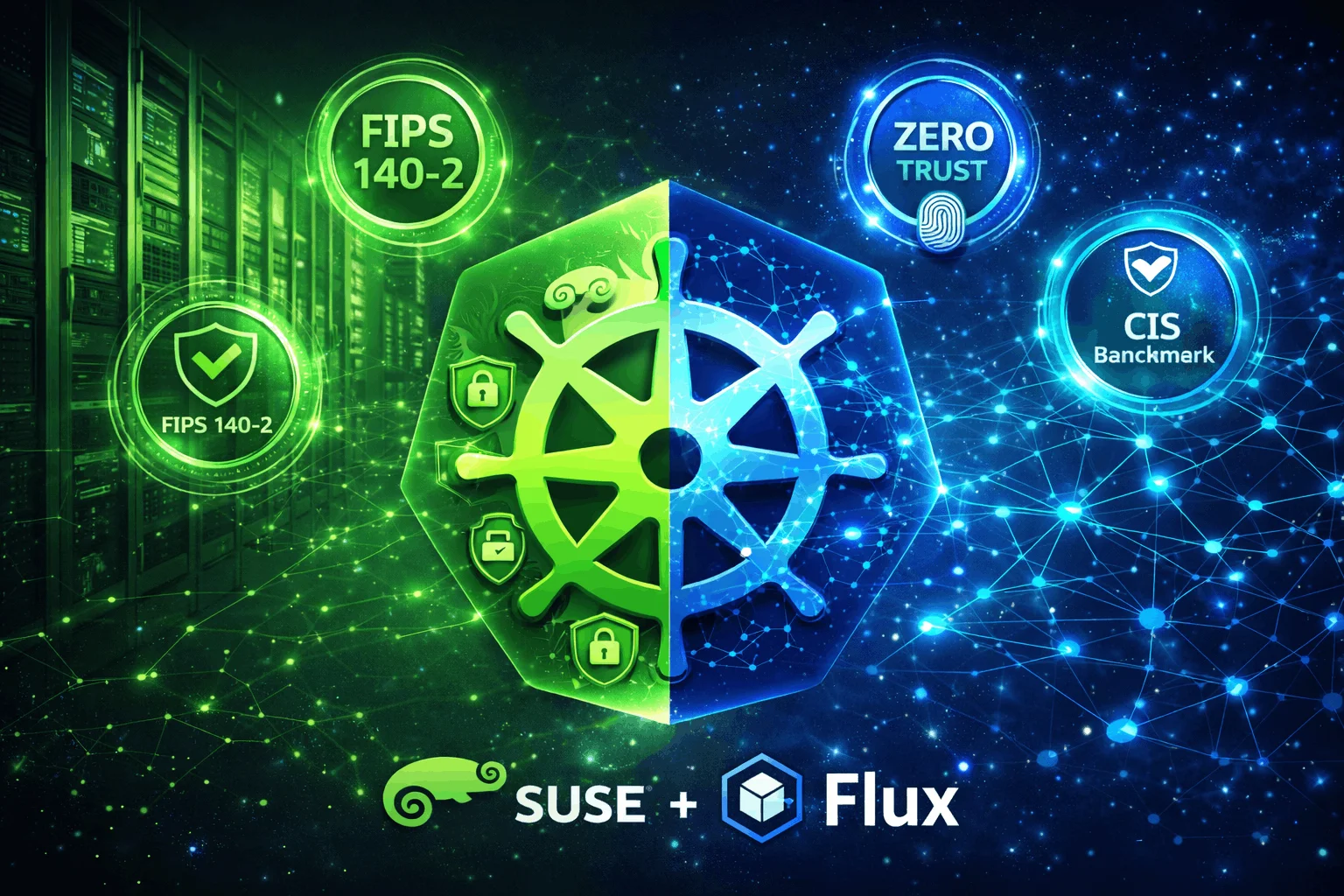
SUSE + Flux: The First Decentralized Kubernetes Infrastructure at Enterprise Standards
How a strategic partnership redefines the boundaries between Web2 and Web3
The global Kubernetes market reached $2.57 billion in 2025 and is projected to grow to $7.07 billion by 2030, with a CAGR of 22.4% according to Mordor Intelligence. In this context of massive enterprise adoption -- 96% of large enterprises now use or evaluate Kubernetes for their production workloads -- a fundamental question emerges: can decentralized infrastructures rival the security and compliance standards demanded by enterprises?
On April 16, 2024, Flux provided a concrete answer by announcing its partnership with SUSE, creating what both companies describe as "the first decentralized compute network using industry standards for a secure and reliable environment with minimal single points of failure." This collaboration integrates RKE2, SUSE's FIPS 140-2 compliant Kubernetes distribution, and NeuVector, its Zero Trust container security platform, within the FluxEdge infrastructure.
This article provides an in-depth analysis of this partnership: its technical architecture, its implications for the DePIN (Decentralized Physical Infrastructure Networks) ecosystem, and its potential to transform enterprise adoption of decentralized cloud. At a time when 59% of Kubernetes adopters cite compliance as their main challenge, does this SUSE-Flux alliance represent a strategic turning point for the industry?
Part 1: The Actors -- Two Philosophies, One Common Vision
InFlux Technologies: Pioneer of Decentralized Cloud
InFlux Technologies, founded in 2018 under the name Zel Technologies in Cambridge (United Kingdom), operates one of the largest decentralized compute networks in the world. With over 8,000 active nodes spread across 67 countries, Flux provides a distributed cloud infrastructure enabling the deployment of Docker applications on a fully decentralized network.
CEO and co-founder Daniel Keller summarizes the company's mission: "Our mission is to propel toward a future where technological integration transcends boundaries, operating seamlessly and dynamically across all sectors." This vision materialized through significant expansion in 2024, including an NVIDIA partnership for enterprise GPUs, recognition by the World Future Awards as one of the top 100 crypto and blockchain companies, and the launch of FluxEdge, a decentralized compute marketplace.
Flux's business model relies on multiple revenue streams: FluxEdge (compute marketplace), FluxAI (AI tool suite), and network fees. The company explicitly targets a one-billion-dollar market capitalization according to Daniel Keller's Pulse2.0 interview in November 2025.
SUSE: The Enterprise Open Source Giant
SUSE, listed on the Frankfurt Stock Exchange, represents a heavyweight in enterprise infrastructure. The German company employs over 2,400 people and its open-source solutions power the critical workloads of more than 60% of Fortune 500 companies.
The acquisition of Rancher Labs in December 2020 for $600-700 million (according to CNBC) transformed SUSE into a leader in the enterprise Kubernetes market. Rancher, founded in 2014 in Cupertino by Sheng Liang, had been designated a "leader" in the Forrester Wave™ Multicloud Container Development Platforms Q3 2020. This acquisition enabled SUSE to offer an integrated portfolio: SUSE Linux Enterprise (OS), Rancher Prime (multi-cluster Kubernetes management), RKE2 (secure Kubernetes distribution), and NeuVector (Zero Trust container security).
Greg Muscarella, General Manager of Enterprise Container Management at SUSE, emphasizes: "Our customers know they can count on SUSE to deliver a comprehensive solution that enhances security throughout the Kubernetes lifecycle."
Cross Strategic Motivations
For Flux, this partnership addresses an imperative for enterprise legitimation. Decentralized clouds face a credibility deficit with traditional enterprises, which demand security certifications (FIPS, SOC2) and regulatory compliance guarantees (GDPR, HIPAA). The association with SUSE brings this legitimacy immediately.
For SUSE, although the company has not published an official press release detailing its motivations, the partnership offers exposure to the rapidly growing DePIN sector. The container and Kubernetes security market is expected to reach $9.41 billion by 2033 according to IMARC Group, and decentralized infrastructures represent an emerging segment where SUSE can establish an early presence.
Part 2: Technical Architecture -- Enterprise-Grade Meets Decentralization
RKE2: Government-Ready Kubernetes
At the heart of the partnership lies RKE2 (Rancher Kubernetes Engine 2), also known as "RKE Government." This Kubernetes distribution was specifically designed to meet the security requirements of the U.S. government sector.
Key features of RKE2:
- •FIPS 140-2 Compliance: The FIPS (Federal Information Processing Standard) 140-2 standard validates the cryptographic modules used by U.S. government agencies. RKE2 is compiled with FIPS-validated cryptographic libraries using the GoBoring compiler, ensuring that all encryption operations meet federal requirements.
- •CIS Kubernetes Benchmark: RKE2 is configured by default to pass CIS (Center for Internet Security) benchmarks with minimal manual intervention. According to SUSE documentation: "RKE2 provides default values and configuration options that allow clusters to pass the CIS Kubernetes Benchmark v1.6 or v1.23 with minimal operator intervention."
- •Modern container runtime: Unlike RKE1 which used Docker (whose support was dropped by Kubernetes in version 1.24), RKE2 uses containerd, the industry-standard runtime.
- •Multi-environment support: Windows Server 2022, ARM architectures, and air-gapped environments (disconnected from the internet) are natively supported.
Integrating RKE2 into FluxEdge means that Kubernetes clusters deployed on the Flux decentralized network benefit from the same security certifications as traditional government deployments.
NeuVector: Zero Trust for Containers
NeuVector, acquired by SUSE and made open source in January 2022 (under the Apache v2 license), is the only fully open-source Zero Trust container security platform on the market.
NeuVector security architecture:
- •Deep Packet Inspection (DPI) Layer 7: NeuVector analyzes network traffic down to the application level, detecting DDoS attacks, SQL injections, DNS tunneling, and Kubernetes-specific threats. It is the only container firewall in the industry offering Layer 7 inspection.
- •East-West Microsegmentation: The system automatically learns legitimate network connections between containers and blocks unauthorized traffic, applying granular Zero Trust policies.
- •Zero-Drift Protection: NeuVector monitors processes and files inside containers, authorizing only processes derived from the original container image. Any attempt to execute unauthorized commands (e.g., /bin/bash in a compromised Node.js container) is immediately blocked.
- •Automated CVE Scanning: Native integration into CI/CD pipelines to scan container images and identify vulnerabilities before deployment.
- •Multi-platform support: Compatible with RKE2, K3s, OpenShift, EKS, GKE, AKS, and other CNCF-certified Kubernetes distributions.
FluxEdge: The Decentralized Compute Marketplace
FluxEdge, launched in public alpha in June 2024, represents the marketplace layer of the Flux network. Daniel Keller describes the platform: "FluxEdge enables users to leverage a vast network of unused CPUs and GPUs for demanding tasks such as artificial intelligence, machine learning, and graphical rendering."
SUSE-FluxEdge Technical Integration:
The architecture combines globally distributed FluxEdge nodes with RKE2 orchestration and NeuVector security:
- 1
Provisioning
Kubernetes clusters are deployed on FluxEdge nodes via RKE2, ensuring FIPS-compliant configuration from initialization.
- 2
Runtime Security
NeuVector continuously monitors deployed workloads, applying Zero Trust policies and detecting anomalous behaviors.
- 3
Compliance
The official press release states that this integration "includes assurance of adherence to regulatory standards such as GDPR and HIPAA and providing clients with a secure and compliant infrastructure."
Innovations Compared to the Existing Landscape
This partnership creates a unique value proposition within the ecosystem:
| Feature | Flux + SUSE | AWS EKS | Akash Network | Render Network |
|---|---|---|---|---|
| FIPS 140-2 | Yes (via RKE2) | Yes | No | No |
| Native Zero Trust | Yes (NeuVector) | Partial | No | No |
| Decentralization | Yes (8,000+ nodes) | No | Yes | Yes |
| Open Source | Yes (100%) | Partial | Yes | Partial |
| CIS Benchmark | Yes (by default) | Manual | No | No |
Limitations and Identified Challenges
Operational complexity: Combining a decentralized infrastructure with enterprise standards adds a layer of complexity. Administrators must master both Web3 paradigms (distributed nodes, consensus) and enterprise practices (compliance, auditing).
Partnership dependency: FIPS compliance relies on the SUSE integration. Any evolution of this partnership could impact certifications.
Ecosystem maturity: FluxEdge remains in beta phase. Large-scale stability with critical enterprise workloads has not yet been demonstrated in production.
Part 3: Market Implications -- Strategic Repositioning of Flux
Impact on the FLUX Ecosystem
This partnership positions Flux as the first DePIN network with formal enterprise credentials. The direct implications include:
Access to the government market: FIPS 140-2 compliance is mandatory for vendors working with the U.S. federal government. This market, traditionally inaccessible to crypto projects, potentially opens up to Flux.
Competitive differentiation: In the DePIN ecosystem, no major competitor (Akash, Render, Filecoin) offers a comparable enterprise integration. This differentiation could attract enterprise clients seeking a decentralized alternative to hyperscalers.
FLUX token utility: Enterprise deployments on FluxEdge require payments in FLUX, creating additional structural demand for the token.
Competitive Positioning
Against hyperscalers (AWS, Azure, GCP), Flux now offers:
- •Potentially lower costs (distributed resources vs. centralized data centers)
- •Enhanced resilience (no single point of failure)
- •The same security compliance (FIPS, CIS)
- •Data sovereignty (controlled geographic deployment)
Against DePIN competitors:
- •Akash Network offers a similar compute marketplace but without formal enterprise certifications
- •Render Network focuses on GPU rendering, not general Kubernetes infrastructure
- •Filecoin targets storage, not compute
Opportunities Created
Healthcare sector: The HIPAA compliance explicitly mentioned in the announcement opens the healthcare data market. FluxAgents, Flux's AI platform, already displays SOC2 Type II and HIPAA compliance certifications.
Financial services: Financial institutions subject to strict regulatory requirements can now consider a decentralized infrastructure without compromising their compliance posture.
Edge computing: SUSE Edge 3.0, launched simultaneously in April 2024, complements the offering for peripheral deployments with low connectivity.
Risks and Uncertainties
Uncertain enterprise adoption: Traditional enterprises remain cautious toward blockchain technologies. Compliance documentation does not guarantee effective adoption.
Regulatory evolution: The crypto regulatory landscape is evolving rapidly. New requirements could necessitate continuous adaptations.
Hyperscaler competition: AWS, Azure, and GCP could intensify their edge/hybrid Kubernetes offerings, reducing Flux's competitive advantage.
Part 4: Perspectives and Future Developments
Technical Roadmap
According to official communications and Daniel Keller's Pulse2.0 interview (November 2025):
2024-2025:
- •FluxEdge transition to public beta (H2 2024) then general availability
- •Expansion of NeuVector integrations across the entire FluxCloud network
- •Launch of ArcaneOS (March 2025) with System Attestation Service for enhanced security
Medium term:
- •Dedicated Cloud and Enterprise Sales division
- •Expansion of rendering capabilities and infrastructure for AI/ML workloads
- •Additional partnerships with certified compliance providers
Daniel Keller states: "Our 2025 roadmap focuses on expanding our rendering capabilities and enhancing our core infrastructure to meet the growing demands of AI and ML workloads."
Success Indicators to Monitor
- 1
Measurable enterprise adoption
Number of enterprise clients using FluxEdge with formal SLAs.
- 2
Compute volume
FluxEdge usage metrics (GPU-hours, deployed clusters).
- 3
Additional certifications
Extension toward SOC2, ISO 27001, FedRAMP.
- 4
Validated partnerships
Announcements of enterprise or government clients using the solution.
- 5
SUSE partnership evolution
Deepening of technical integration, co-marketing efforts.
Open Questions
Depth of SUSE integration: Is this a technology license or a deeper strategic partnership? SUSE has not published an official press release detailing its commitment.
Enterprise scalability: Can FluxEdge support critical workloads at scale? Performance benchmarks in enterprise environments are not publicly available.
Support model: What level of enterprise support is offered? SLAs, availability guarantees, and escalation processes remain to be clarified.
Conclusion
The SUSE-Flux partnership announced on April 16, 2024 represents a significant advancement for the DePIN industry. By integrating RKE2 (FIPS 140-2 compliant Kubernetes) and NeuVector (Zero Trust container security) into FluxEdge infrastructure, Flux becomes the first decentralized compute network offering formal enterprise security standards.
This collaboration directly addresses the main obstacle to enterprise adoption of decentralized cloud: compliance. Enterprises and government agencies now have a decentralized option that does not compromise their security and regulatory compliance requirements.
However, documentation and certifications alone are not enough. The success of this partnership will be measured by actual adoption by enterprise clients, large-scale production performance, and Flux's ability to transform this technical legitimacy into sustainable revenue. The next 12-18 months will be decisive in evaluating whether this SUSE-Flux alliance establishes a new standard for enterprise decentralized cloud infrastructure.
For investors and infrastructure professionals, this partnership warrants sustained attention: it could define the trajectory of convergence between enterprise Web2 and decentralized Web3.
Sources and References
Sources & Further Reading
- GlobeNewswire -- Flux Partners with SUSE to Transform Web Infrastructure Through Decentralization (April 2024)
- SUSE -- Completes Acquisition of Rancher Labs (December 2020)
- SUSE -- Transforms Cloud Native Security (NeuVector 5.0, Rancher 2.6.5) (May 2022)
- GlobeNewswire -- Flux Launches FluxEdge Alpha (June 2024)
- PRNewswire -- SUSE Strengthens Container Management Portfolio (Rancher Prime 3.0) (March 2024)
- SUSE Documentation -- RKE2 FIPS 140-2 Enablement
- SUSE Documentation -- RKE2 Overview
- NeuVector -- Platform Specifications
- SUSE Communities -- NeuVector for Kubernetes Security and Compliance
- NeuVector Docs -- System Requirements
- TFiR -- Flux, SUSE to transform Web infrastructure through decentralization (April 2024)
- StreetInsider -- Flux Partners with SUSE (April 2024)
- Finanznachrichten -- InFlux Technologies Ltd.: Flux Partners with SUSE (April 2024)
- Pulse2.0 -- InFlux Technologies: Interview With Co-Founder & CEO Daniel Keller (November 2025)
- RunOnFlux -- FluxEdge Marketplace
- Flux Medium -- FluxEdge Alpha, Testing the Compute Marketplace of the Future (April 2024)
- World Future Awards -- Top 100 Crypto and Blockchain Company: Flux (March 2025)
- TechCrunch -- Suse acquires Kubernetes management platform Rancher Labs (July 2020)
- CNBC -- Linux company SUSE outbids competitors for Rancher Labs (July 2020)
- Wikipedia -- Rancher Labs
- Mordor Intelligence -- Kubernetes Market Size & Share Analysis
- Edge Delta -- Latest Kubernetes Adoption Statistics (March 2025)
- SkyQuest -- Kubernetes Market Growth (2025)
- IMARC Group -- Container and Kubernetes Security Market (2025)
- InfoQ -- SUSE Announces Upgrades to Kubernetes and Edge Management Products (March 2024)
- Datanami -- SUSE Announces Significant Advancements to NeuVector and Rancher (May 2022)
- SUSE Communities -- SUSE NeuVector 5.0 Delivers a Powerful Open Source Security Platform (May 2023)
- Rancher -- About Us
Other articles you might enjoy
FLUX: The Complete Guide to the World's Largest Decentralized Cloud & DePIN
Comprehensive guide to Flux — the 'AWS of Web3'. 10,000+ nodes, 66+ countries, NVIDIA Partner, PoUW v2, FluxEdge AI/GPU marketplace, tokenomics, investment analysis, and full ecosystem overview.
FLUX / RunOnFlux: Complete Ecosystem Cartography — Institutional Investigation
Exhaustive institutional-level research document with verified primary sources. All strategic partnerships, products, tokenomics, case studies, governance, compliance, roadmap, and 100+ referenced sources.
Flux Abandons GPU Mining: Complete Analysis of the PoUW v2 Fork
The historic transition at block 2,020,000 that eliminates GPU mining in favor of a node-centric model. Technical analysis, economic implications, and what it means for DePIN.
FluxCloud vs AWS: 98% Cheaper, But at What Cost?
Comparative analysis of FluxCloud against AWS, Azure, and GCP. Real pricing data, technical trade-offs, case studies, and the AWS October 2025 outage that proved decentralization's value.