From Startup to NVIDIA Partner: How InFlux Technologies Conquered the GPU Giant
InFlux Technologies (enterprise arm of Flux) becomes the first blockchain-affiliated company to reach the NVIDIA Partner Network. From Inception Program (2022) to NPN Solution Advisor (2025), with FluxEdge GPU marketplace and Blackwell deployment.
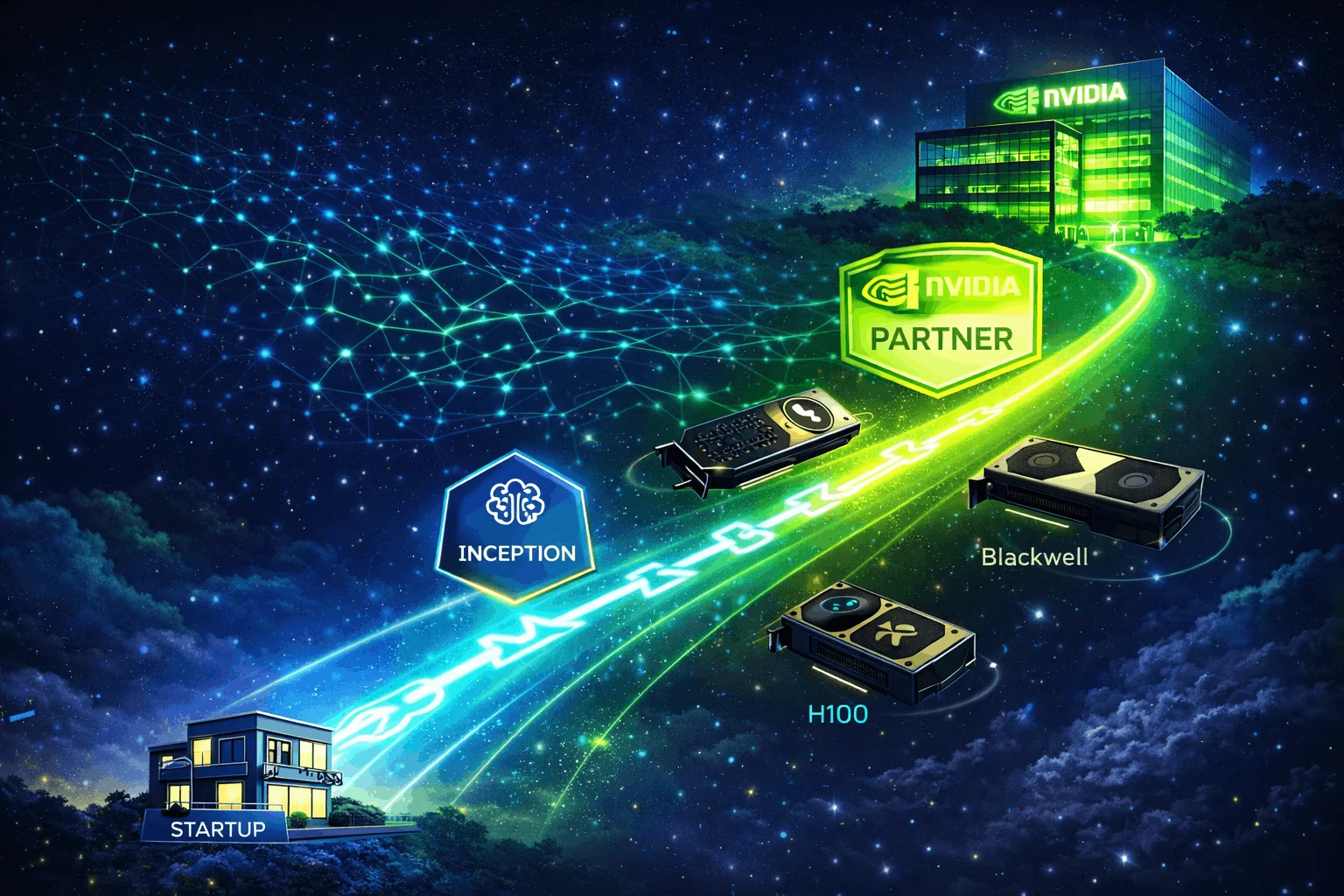
From Startup to NVIDIA Partner: How InFlux Technologies Conquered the GPU Giant
InFlux Technologies, the enterprise arm of the Flux ecosystem, becomes the first blockchain-affiliated company to reach the NVIDIA Partner Network — analysis of an exceptional trajectory
In the world of enterprise technology, earning NVIDIA's stamp of approval is the equivalent of receiving a knighthood. When InFlux Technologies — the enterprise entity of the Flux ecosystem — became the first blockchain-affiliated company to join the NVIDIA Partner Network (NPN) as a Solution Advisor, it was not just a milestone for Flux — it was a signal that decentralized computing had earned a seat at the enterprise table. An important distinction: the NPN partnership is officially held by InFlux Technologies, not by RunOnFlux directly. This article traces the complete trajectory: from Flux's initial Inception Program membership to InFlux Technologies' NPN Partner status, and analyzes what this partnership means for the future of decentralized GPU computing.
Part 1: Actors and Context
NVIDIA: From GPU Maker to AI King
NVIDIA's transformation from a graphics card manufacturer to the most important company in the AI revolution is one of the most remarkable corporate pivots in technology history. The numbers tell the story:
- •80%+ market share in AI training and inference chips
- •$3 trillion+ market capitalization — among the most valuable companies on Earth
- •H100 GPUs priced at $25,000–$40,000 each, with demand consistently outstripping supply
- •Software ecosystem: NIM (inference microservices), NeMo (LLM framework), and CUDA (parallel computing platform) form the foundation of modern AI development
NVIDIA's dominance is not just hardware — it is the entire AI development stack. CUDA's decade-long head start means that virtually all AI frameworks (PyTorch, TensorFlow, JAX) are optimized for NVIDIA GPUs first. This creates an ecosystem lock-in that competitors like AMD and Intel are struggling to break.
The NVIDIA Inception Program
NVIDIA's Inception Program is the primary gateway for startups to access NVIDIA's enterprise ecosystem. With over 19,000 members, it provides free access to technical resources, training, and co-marketing opportunities. Membership is free and relatively accessible for technology startups.
However, a critical development occurred in April 2025: NVIDIA excluded crypto-focused companies from the Inception Program. This decision reflected growing regulatory scrutiny and NVIDIA's desire to distance its brand from speculative crypto projects. As Cointelegraph reported at the time, this made the road significantly harder for blockchain projects seeking NVIDIA integration — making Flux's prior ascent to NPN status all the more significant.
Flux joined the Inception Program in January 2022, well before the April 2025 exclusion of crypto companies. By the time the door closed, InFlux Technologies — the enterprise arm of the Flux ecosystem — had already advanced to NPN Solution Advisor status, a distinction that separates it from the thousands of Inception members. Note: the NPN partnership is officially with InFlux Technologies, not with RunOnFlux directly.
Flux: The Strategic Pivot from ZelCash
Flux's journey to NVIDIA partnership began with a fundamental identity shift. As ZelCash, the project was a privacy-focused cryptocurrency — a category that would likely never earn enterprise technology partnerships. The rebranding to Flux and the pivot to decentralized cloud infrastructure repositioned the project as a technology platform rather than a speculative asset.
Daniel Keller described the moment Flux joined the Inception Program in January 2022 with palpable excitement: "I woke up with a smile." For a project with roots in cryptocurrency mining, being accepted by the world's most important compute company validated years of strategic positioning.
Keller's background in mining was, paradoxically, an asset. Understanding GPU hardware at a deep technical level — power consumption, thermal management, workload optimization — gave the Flux team credibility when discussing compute infrastructure with NVIDIA's technical teams.
N3XGen Cloud: The GPU Supply Partner
N3XGen Cloud plays a critical role in making the NVIDIA partnership tangible. As the primary hardware partner for FluxEdge, N3XGen provides the physical GPU infrastructure that Flux's decentralized marketplace needs.
Chris Starkey, representing N3XGen, outlined the scope of the partnership: the company provides access to NVIDIA H100s, A100s, and plans for Blackwell-generation GPUs. This is not a small commitment — H100 clusters alone represent millions of dollars in hardware investment.
The N3XGen partnership solves a fundamental challenge for decentralized GPU marketplaces: supply consistency. While peer-to-peer GPU sharing (as offered by competitors) depends on variable consumer hardware availability, N3XGen provides enterprise-grade hardware with guaranteed availability — bridging the gap between decentralized architecture and enterprise reliability expectations.
Part 2: Technical Integration Analysis
Inception Program vs NVIDIA Partner Network
Understanding the distinction between NVIDIA Inception and NPN is critical to appreciating what Flux achieved. These are fundamentally different tiers:
| Criteria | Inception Program | NVIDIA Partner Network (NPN) |
|---|---|---|
| Access Level | Basic technical resources, training | Full enterprise partnership with co-engineering |
| Cost | Free | Requires demonstrated revenue and business case |
| Members | 19,000+ startups | Select enterprise partners only |
| Technical Support | Community forums, documentation | Dedicated NVIDIA engineering support |
| Co-Marketing | Logo usage, basic promotion | Joint marketing campaigns, case studies, events |
| Hardware Access | Standard pricing | Priority allocation, early access to new hardware |
Moving from Inception to NPN is not an automatic progression — it requires demonstrating real commercial traction, technical integration depth, and strategic alignment with NVIDIA's business objectives. InFlux Technologies (the enterprise entity of Flux) is the first and only blockchain-affiliated company to achieve this distinction as NPN Solution Advisor.
FluxEdge: The Decentralized GPU Marketplace
FluxEdge is the product that justifies the NVIDIA partnership. It is a decentralized marketplace for GPU compute that connects AI developers with GPU resources across the Flux network:
- •GPU Catalog: Available hardware includes NVIDIA RTX 4090, H100, and A100 GPUs, with Blackwell-generation GPUs planned
- •Kubernetes Orchestration: GPU workloads are managed through Kubernetes clusters, providing familiar tooling for enterprise DevOps teams
- •NIM and NeMo Integration: Direct integration with NVIDIA's AI Enterprise software — NIM for inference optimization and NeMo for LLM fine-tuning and deployment
- •Regional Deployment: GPU resources can be deployed in specific geographic regions to meet data residency and latency requirements
The integration with NVIDIA's software stack is what distinguishes FluxEdge from generic GPU rental services. By supporting NIM and NeMo natively, FluxEdge offers a deployment experience that is compatible with enterprise AI workflows — not a separate, unfamiliar toolchain.
Blackwell GPU Deployment
NVIDIA's Blackwell architecture represents the next generation of AI compute:
- •208 billion transistors — the most complex chip ever manufactured
- •30x performance improvement over H100 for LLM inference workloads
- •Designed for trillion-parameter model training and real-time inference at scale
Through the N3XGen partnership, FluxEdge plans to offer the first decentralized deployment of Blackwell GPUs. This is significant for several reasons: it demonstrates that NVIDIA's cutting-edge hardware can operate within a decentralized orchestration framework, it positions Flux as a first-mover in next-gen AI compute, and it validates the technical maturity of FluxEdge's Kubernetes-based GPU management.
NVIDIA AI Enterprise Integration
The NPN partnership provides InFlux Technologies — and by extension the Flux ecosystem — with access to the full NVIDIA AI Enterprise software suite:
- •NIM (NVIDIA Inference Microservices) — Pre-optimized inference containers that dramatically reduce the engineering effort required to deploy AI models in production. NIM containers handle model optimization, batching, and scaling automatically.
- •NeMo — NVIDIA's framework for building, customizing, and deploying large language models. NeMo supports fine-tuning, RLHF (Reinforcement Learning from Human Feedback), and multi-GPU training orchestration.
- •Full NVIDIA AI Enterprise Suite — Including tools for data processing, model monitoring, and MLOps workflows that enterprise AI teams expect.
This software integration is arguably more valuable than the hardware access. Enterprise AI teams standardize on NVIDIA's tools — by supporting them natively, FluxEdge becomes a drop-in alternative to centralized GPU cloud providers rather than requiring teams to adapt their workflows.
The PoUW Conceptual Bridge
The NVIDIA partnership creates a compelling narrative link to Flux's broader Proof of Useful Work philosophy. Daniel Keller articulated this vision as early as 2022:
"Instead of wasting compute on meaningless hashes, we can use it for deepfake detection, 3D rendering, and machine learning training. That's what Proof of Useful Work really means." — Daniel Keller, 2022
The NVIDIA partnership is the concrete realization of this vision. FluxEdge, powered by NVIDIA GPUs and software, transforms "useful work" from a philosophical concept into a marketplace with real customers paying for real AI compute. Node operators are rewarded not for solving arbitrary puzzles but for providing productive GPU resources that advance AI research and deployment.
Part 3: Market Implications
Critical Timing and Strategic Significance
The timing of InFlux Technologies' NPN achievement is particularly noteworthy given NVIDIA's evolving relationship with the crypto industry:
- •April 2025: NVIDIA excludes crypto companies from the Inception Program, effectively closing the door for future blockchain projects seeking partnership
- •2022: NVIDIA paid a $5.5 million fine to the SEC for failing to disclose that a significant portion of GPU sales were driven by cryptocurrency mining demand. This regulatory action shaped NVIDIA's subsequent wariness toward crypto-affiliated companies.
- •Coin Edition's analysis highlighted that InFlux Technologies' NPN status was achieved despite — not because of — NVIDIA's crypto stance, demonstrating that the positioning as infrastructure rather than cryptocurrency was the decisive factor.
InFlux Technologies' ability to earn NPN status while other crypto projects were being excluded illustrates the success of the Flux ecosystem's rebranding strategy. By positioning as a decentralized cloud computing platform that happens to use a blockchain for coordination, rather than a cryptocurrency project that happens to offer compute, InFlux Technologies navigated NVIDIA's anti-crypto sentiment successfully.
First Blockchain in NPN: What It Means
Being the first blockchain-affiliated company in the NVIDIA Partner Network (through InFlux Technologies) confers three distinct advantages:
- 1
Enterprise Credibility
The NVIDIA brand serves as a trust signal for enterprise buyers. CIOs and CTOs who would never consider a "crypto platform" will evaluate a solution that carries the NVIDIA partner badge. This is not merely perception — NVIDIA conducts rigorous technical and business reviews before granting NPN status.
- 2
Technology Access
NPN partners receive early access to new hardware and software, dedicated engineering support, and priority allocation during supply constraints. For GPU compute, where demand chronically exceeds supply, this access is a critical competitive advantage. It means FluxEdge can offer the latest NVIDIA hardware faster than competitors who must go through standard procurement channels.
- 3
Co-Marketing and Visibility
Joint marketing initiatives, conference presentations, and case studies with NVIDIA provide visibility that no amount of marketing budget could buy. When NVIDIA features a partner at GTC (GPU Technology Conference) or in technical documentation, it reaches an audience of enterprise decision-makers who trust NVIDIA's endorsement.
Risks and Challenges
The NVIDIA partnership, while strategically valuable, introduces risks that must be carefully managed:
- 1
Technology Dependency
Deep integration with NVIDIA's ecosystem creates dependency. If NVIDIA changes its partnership terms, modifies API access, or decides to distance itself from blockchain projects, Flux would face significant disruption. Diversifying hardware support (AMD, Intel) would mitigate this but requires substantial engineering investment.
- 2
Apparent Contradiction
There is an inherent tension between NVIDIA's corporate identity (centralized, for-profit, regulatory-cautious) and Flux's decentralized ethos. Crypto community members may view the partnership as a compromise of decentralization principles, while enterprise buyers may question the reliability of blockchain-based infrastructure.
- 3
Internal Competition from Hyperscalers
NVIDIA's most important customers are AWS, Google Cloud, and Microsoft Azure — companies that compete directly with FluxEdge for GPU compute workloads. If hyperscalers pressure NVIDIA to limit support for decentralized competitors, the partnership could face constraints.
- 4
Decentralized SLA Challenges
Enterprise customers who adopt FluxEdge based on the NVIDIA partnership will expect enterprise-grade SLAs. Delivering consistent performance guarantees across a decentralized network of nodes is fundamentally more challenging than in a centralized data center. Any SLA failures could reflect poorly on both Flux and NVIDIA.
Part 4: Perspectives and Future Outlook
FluxEdge Roadmap 2025–2026
The NVIDIA partnership accelerates FluxEdge's development trajectory. The planned milestones include:
- 1
GPU Expansion
Scaling the available GPU catalog beyond current RTX 4090, H100, and A100 offerings to include Blackwell-generation GPUs (via N3XGen) and expanding the geographic distribution of GPU nodes.
- 2
Enterprise Division
A dedicated enterprise sales and support division to serve organizations that require SLAs, compliance documentation, and dedicated account management — matching the expectations set by the NVIDIA partnership.
- 3
Kraken Flux-Ink Integration
The Kraken exchange listing and Flux-Ink parallel asset system create new liquidity channels and payment mechanisms for FluxEdge services, potentially enabling fiat-denominated pricing for enterprise customers.
- 4
FluxPay
A payment processing system designed to simplify how enterprise customers purchase GPU compute, abstracting away cryptocurrency complexity for organizations that prefer traditional payment methods.
Success Indicators to Monitor
- 1
FluxEdge GPU Utilization Rate
The percentage of available GPU capacity that is actively rented. High utilization validates market demand; low utilization suggests a supply-demand mismatch that needs addressing.
- 2
Enterprise Customer Count
The number of non-crypto enterprise customers using FluxEdge for production AI workloads. This is the ultimate validation that the NVIDIA partnership translates into real business traction.
- 3
NVIDIA Joint Activities
Conference appearances, published case studies, and co-engineered solutions with NVIDIA will indicate the depth and health of the partnership relationship.
- 4
Competitive Response
Whether other decentralized GPU platforms (Akash, Render, io.net) attempt to secure similar NVIDIA partnerships will validate Flux's first-mover advantage or reveal potential commoditization of the NPN relationship.
- 5
Blackwell Deployment Timeline
Successfully deploying Blackwell GPUs on FluxEdge before centralized competitors would be a powerful demonstration of the partnership's technical value.
Open Questions
- •Will NVIDIA deepen its integration with Flux, or is the NPN status a ceiling beyond which blockchain projects cannot advance? The exclusion of crypto from Inception suggests NVIDIA's comfort level with blockchain has limits.
- •Can FluxEdge compete on performance and reliability with centralized GPU cloud providers (CoreWeave, Lambda Labs, AWS) that also hold deep NVIDIA partnerships and operate in controlled data center environments?
- •Will the NVIDIA partnership attract enterprise customers at a pace sufficient to justify the infrastructure investment, or will the "blockchain" label continue to be a barrier for risk-averse enterprise procurement teams?
Conclusion
The Flux ecosystem's journey from ZelCash to NVIDIA Partner Network is a masterclass in strategic repositioning. By pivoting from cryptocurrency to cloud infrastructure, building a production-grade GPU marketplace, and relentlessly pursuing enterprise partnerships, InFlux Technologies has achieved something no other blockchain-affiliated company has accomplished: earning NVIDIA's endorsement as a legitimate technology partner through NPN Solution Advisor status.
The timing could not be more critical. With NVIDIA closing the door on crypto projects in its Inception Program and the AI compute market experiencing unprecedented demand, InFlux Technologies' NPN status is a moat that competitors cannot easily replicate. The H100 and Blackwell GPU access, NIM and NeMo software integration, and co-marketing opportunities create a flywheel that reinforces the Flux ecosystem's enterprise positioning.
The challenges are real — technology dependency, the inherent tension between decentralization and enterprise expectations, and competition from hyperscalers who are NVIDIA's largest customers. But with the PoUW v2 fork aligning economic incentives, the SUSE partnership providing compliance credentials, and N3XGen ensuring hardware supply, Flux has assembled the most comprehensive enterprise ecosystem in the DePIN sector.
Whether this exceptional trajectory translates into sustained enterprise adoption remains to be seen. But one thing is certain: by becoming the first blockchain-affiliated company in the NVIDIA Partner Network through InFlux Technologies, the Flux ecosystem has fundamentally changed what is possible for decentralized infrastructure platforms.
Sources & Further Reading
- NVIDIA Partner Network — Official Program
- NVIDIA Inception Program
- NVIDIA SEC Fine — $5.5M Settlement (2022)
- Cointelegraph — NVIDIA Crypto Exclusion Analysis
- Coin Edition — Flux NPN Partnership Analysis
- FluxEdge — GPU Compute Marketplace
- N3XGen Cloud — GPU Infrastructure Partner
- NVIDIA AI Enterprise — Software Suite
- NVIDIA NIM — Inference Microservices
- NVIDIA NeMo — LLM Framework
- NVIDIA Blackwell Architecture
- Daniel Keller — Flux Inception Program Announcement (January 2022)
- Flux Official Documentation
Other articles you might enjoy
FLUX: The Complete Guide to the World's Largest Decentralized Cloud & DePIN
Comprehensive guide to Flux — the 'AWS of Web3'. 10,000+ nodes, 66+ countries, NVIDIA Partner, PoUW v2, FluxEdge AI/GPU marketplace, tokenomics, investment analysis, and full ecosystem overview.
FLUX / RunOnFlux: Complete Ecosystem Cartography — Institutional Investigation
Exhaustive institutional-level research document with verified primary sources. All strategic partnerships, products, tokenomics, case studies, governance, compliance, roadmap, and 100+ referenced sources.
Flux Abandons GPU Mining: Complete Analysis of the PoUW v2 Fork
The historic transition at block 2,020,000 that eliminates GPU mining in favor of a node-centric model. Technical analysis, economic implications, and what it means for DePIN.
FluxCloud vs AWS: 98% Cheaper, But at What Cost?
Comparative analysis of FluxCloud against AWS, Azure, and GCP. Real pricing data, technical trade-offs, case studies, and the AWS October 2025 outage that proved decentralization's value.