Flux on Kraken: From Listing to Parallel Asset Ink
Anatomy of the Kraken integration: direct listing, Flux-Ink parallel asset on Kraken's L2, future Kraken Earn staking, and what 11 blockchains of interoperability means.
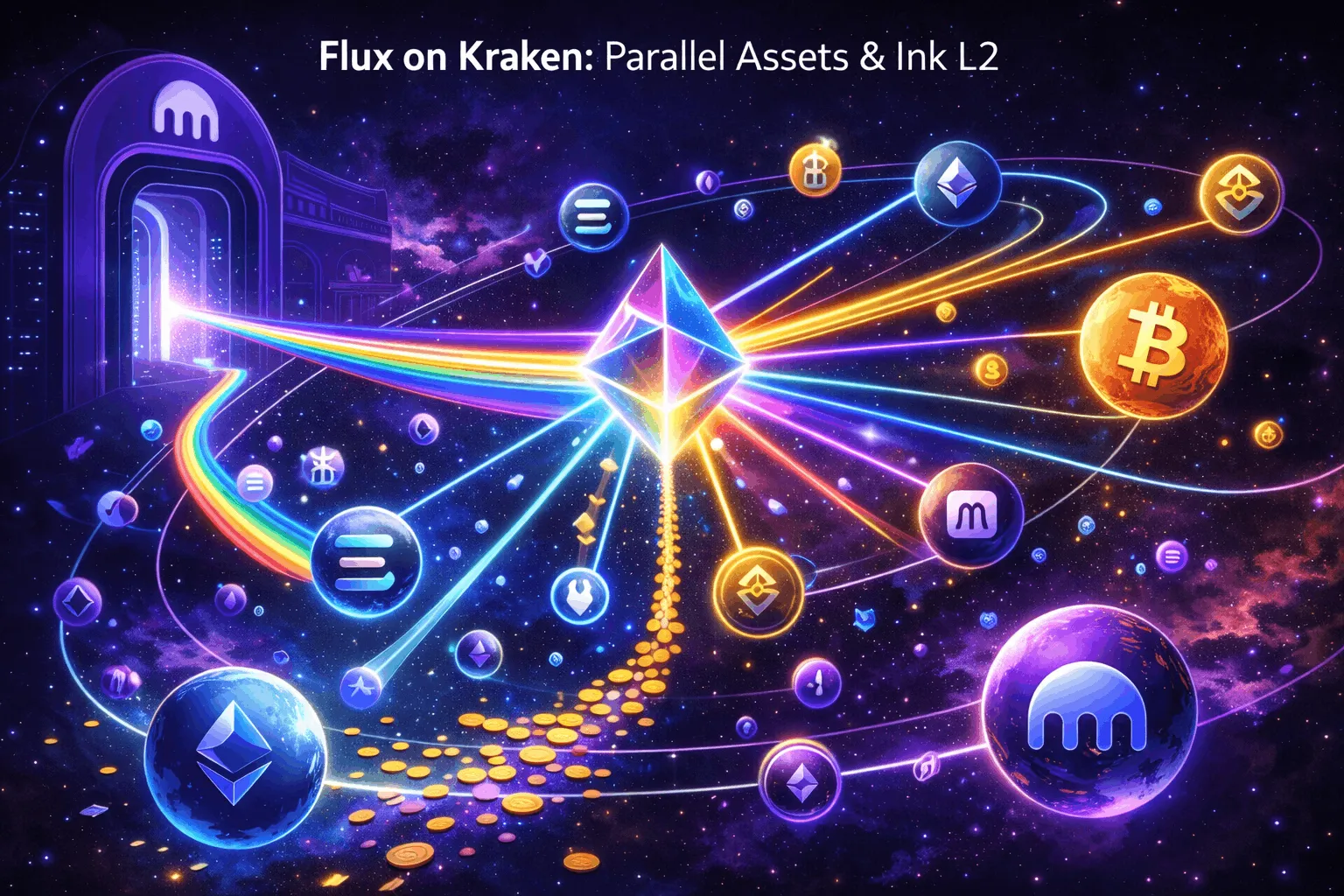
Flux on Kraken: From Listing to Parallel Asset Ink, Anatomy of a Strategic Integration
How Flux extends its cross-chain interoperability to the 6th largest global exchange.
The listing of Flux on Kraken is far more than a simple addition to an exchange's catalog. It marks the convergence of two complementary visions: that of an American veteran of crypto trading, and that of a decentralized cloud infrastructure seeking to expand its reach. With the simultaneous announcement of Flux-Ink as its 11th parallel asset, Flux is strategically embedding itself into the Optimism Superchain ecosystem while gaining access to a regulated, fiat-connected market of over 10 million users. This article dissects every dimension of this strategic integration.
Part 1: The Actors in Play
Kraken: An American Crypto Veteran
Founded in 2011 by Jesse Powell in San Francisco, Kraken is one of the oldest and most respected cryptocurrency exchanges in the world. Today it ranks as the 6th largest exchange globally by trading volume, with over 10 million registered users across 180+ countries.
Kraken is one of the few major exchanges to be US-regulated, operating under strict compliance frameworks. The platform lists 589+ cryptocurrencies and offers fiat trading pairs in USD, EUR, GBP, CAD, CHF, and AUD, making it a critical gateway between traditional finance and the crypto ecosystem.
Kraken's reputation was built on security and transparency. Unlike many competitors that collapsed during the 2022 bear market, Kraken maintained full reserves and continued to expand its product offerings, including futures, staking services, and its own Layer 2 blockchain.
| Characteristic | Details |
|---|---|
| Founded | 2011 by Jesse Powell |
| Headquarters | San Francisco, USA |
| Global Ranking | 6th largest exchange worldwide |
| Registered Users | 10+ million |
| Geographic Reach | 180+ countries |
| Listed Cryptocurrencies | 589+ |
| Fiat Pairs | USD, EUR, GBP, CAD, CHF, AUD |
| Regulatory Status | US-regulated |
Ink: Kraken's Layer 2
Ink is Kraken's proprietary Layer 2 blockchain, built on the Optimism Superchain. It represents Kraken's strategic bet on becoming more than just an exchange: a full-stack blockchain infrastructure provider.
"We are building Ink as part of the Superchain because we believe that the future of DeFi is interoperable, accessible, and affordable." — Andrew Koller, Ink lead at Kraken.
Ink's technical specifications are impressive: a 1-second block time already transitioning toward sub-second finality, with transaction costs between $0.001 and $0.01. The chain natively supports the SuperchainERC20 token standard, enabling seamless cross-chain interoperability with other Superchain L2s.
A critical detail: Kraken serves as the sequencer for Ink, meaning it captures sequencer revenues — a model proven lucrative by Coinbase, which generated $53 million in Q2 2024 from its Base L2 sequencer operations. Ink also implemented permissionless fault proofs in January 2025, enhancing decentralization and trust minimization.
| Feature | Ink L2 Specification |
|---|---|
| Architecture | Optimism Superchain (OP Stack) |
| Block Time | 1 second (moving to sub-second) |
| Transaction Cost | $0.001 — $0.01 |
| Token Standard | SuperchainERC20 |
| Sequencer | Kraken (centralized, revenue-generating) |
| Fault Proofs | Permissionless (January 2025) |
| Sequencer Revenue Model | Proven: Coinbase earned $53M in Q2 2024 with Base |
Flux: Decentralized Cloud Infrastructure
Flux operates a decentralized cloud infrastructure spanning 8,117+ nodes across 67 countries. Its unique innovation lies in its parallel asset architecture, with native representations of the FLUX token deployed across 10 blockchains, enabling deep cross-chain interoperability without relying on traditional wrapped tokens.
The announcement of the Kraken listing came with a major revelation from Daniel Keller, Flux co-founder and project lead:
"Flux-Ink will be deployed on Ink L2, making it our 11th parallel asset. We are also in discussions with Kraken regarding future integration of Flux staking on Kraken Earn." — Daniel Keller, Major Revelations
This dual announcement — a new parallel asset on Ink L2 combined with potential passive yield via Kraken Earn — signals a strategic deepening of the Flux-Kraken relationship beyond a simple listing.
Part 2: Technical Analysis of Parallel Assets
Architecture: Not Wrapped Tokens, but "Expatriate Citizens"
Flux parallel assets are not wrapped tokens in the traditional sense. While wrapped tokens (like WBTC or WETH) rely on a custodian holding the underlying asset and issuing a derivative representation, Flux parallel assets operate as "expatriate citizens" — native representations of FLUX that maintain a 1:1 peg with the main-chain FLUX through a decentralized bridge mechanism.
The mechanism follows a 4-step process:
- 1
Lock
FLUX tokens are locked on the native Flux blockchain via a smart contract, removing them from circulation on the main chain.
- 2
Mint
An equivalent amount of parallel asset tokens is minted on the target blockchain (e.g., Ethereum, BSC, Solana, Ink).
- 3
1:1 Swap
Users can always swap parallel assets back to native FLUX at a strict 1:1 ratio, ensuring there is no premium or discount.
- 4
Fusion App
The Fusion application manages liquidity pools and cross-chain swaps, ensuring seamless movement across all supported chains.
The key differentiator from wrapped tokens: parallel assets are native tokens on each chain, not derivatives. They have their own mining rewards, their own liquidity, and their own ecosystem integration — making them "citizens" of each blockchain rather than mere "visitors."
Complete Parallel Assets Overview
As of 2025, Flux has deployed 10 parallel assets across major blockchain ecosystems, with Flux-Ink announced as the 11th:
| Parallel Asset | Target Blockchain | Launch Date | Status |
|---|---|---|---|
| Flux-KDA | Kadena | April 2021 | Active |
| Flux-ETH | Ethereum | June 2021 | Active |
| Flux-BSC | BNB Smart Chain | June 2021 | Active |
| Flux-SOL | Solana | October 2021 | Active |
| Flux-TRX | Tron | October 2021 | Active |
| Flux-AVAX | Avalanche | Q1 2022 | Active |
| Flux-ERGO | Ergo | Q1 2022 | Active |
| Flux-ALGO | Algorand | Q1 2022 | Active |
| Flux-BTC | Bitcoin | November 2023 | Active |
| Flux-Ink | Ink (Kraken L2) | 2025 | Announced |
Parallel Mining: Additional Rewards
Before the transition to PoUW v2, parallel assets introduced an additional revenue stream for miners and node operators. The reward structure operated as follows:
- •Base block reward: Each block produced 37.5 FLUX on the main chain
- •Parallel asset bonus: Each parallel asset added 3.75 FLUX per block (10% of the base reward) on its respective chain
- •Node operators: Received the same proportional reward structure — base rewards plus parallel asset bonuses
- •Launch airdrops: At the launch of each new parallel asset, existing FLUX holders received airdrops of the new parallel token
Daniel Keller hinted that Flux-Ink would follow a similar reward pattern, with potential airdrops and ongoing parallel mining rewards for existing FLUX holders and node operators, creating an immediate incentive for the community to engage with the Ink ecosystem.
Fusion Bridge: Full Liquidity Guarantee
The Fusion Bridge is the backbone of Flux's cross-chain architecture. Unlike traditional bridges that have suffered billions in exploits (Ronin, Wormhole, Nomad), Fusion operates with a fundamentally different model:
- •Liquidity pools: Each parallel asset pair maintains a dedicated liquidity pool ensuring instant swaps
- •Full liquidity: The bridge guarantees 100% backing — every parallel asset in circulation is backed 1:1 by locked FLUX on the main chain
- •On-chain verification: All swap operations are verifiable on-chain, providing full transparency
- •Arbitrage mechanism: Market makers can arbitrage price discrepancies between parallel assets across chains, maintaining the 1:1 peg through economic incentives
Ink and the Optimism Superchain
By deploying Flux-Ink on the Ink L2, Flux gains access to the broader Optimism Superchain — a network of 30+ interconnected Layer 2 chains that share security and interoperability.
Key Superchain members include:
- •Base (Coinbase's L2)
- •Zora (NFT-focused L2)
- •Unichain (Uniswap's dedicated L2)
- •World Chain (Worldcoin's identity L2)
- •And 25+ additional chains sharing the OP Stack
The SuperchainERC20 standard enables native cross-chain token transfers between all Superchain L2s. This means Flux-Ink holders could potentially move their tokens to Base, Zora, or any other Superchain member without traditional bridging, accessing the full DeFi ecosystem on each chain while maintaining Ethereum's security guarantees as the base settlement layer.
The Superchain interoperability means Flux-Ink is not limited to the Ink ecosystem. It becomes a passport to 30+ Layer 2 environments, each with their own DeFi protocols, liquidity, and user bases — massively expanding Flux's addressable market.
Part 3: Market Implications
US Regulated Market Access
The Kraken listing provides Flux with something that most DePIN projects lack: direct fiat trading pairs. FLUX is now available for trading against FLUX/USD and FLUX/EUR, allowing institutional and retail investors to purchase FLUX directly with fiat currency without the friction of first acquiring another cryptocurrency.
"CoinCodex data shows that the largest fiat volume for FLUX trading is now concentrated on Kraken, making it the primary fiat gateway for the token." — CoinCodex Market Analysis.
This is particularly significant in the US market, where regulatory clarity has been a major barrier for crypto projects. Kraken's compliance infrastructure means that US investors can access FLUX through a regulated platform, reducing counterparty risk and increasing institutional confidence.
Staking and Kraken Earn
Daniel Keller's mention of future integration with Kraken Earn opens a significant new avenue for FLUX holders. Kraken Earn allows users to stake their tokens directly on the platform and receive passive yields without operating a node.
Currently, earning yield on FLUX requires running a full node, which involves:
- •A minimum collateral of 1,000 FLUX (Cumulus tier)
- •Dedicated hardware or a VPS
- •Technical knowledge to set up and maintain the node
- •Ongoing uptime requirements for reward eligibility
Kraken Earn would democratize yield generation by allowing any FLUX holder to earn rewards through a simple staking interface, potentially bringing thousands of non-technical investors into the Flux ecosystem.
Competitive Positioning
The Kraken listing and Ink integration place Flux in a distinctive competitive position among DePIN (Decentralized Physical Infrastructure Network) projects:
| Criteria | Flux | Akash | Render | Filecoin |
|---|---|---|---|---|
| Major Exchange Listings | Kraken, Coinbase, Binance, KuCoin, Gate.io | Kraken, Coinbase, KuCoin | Binance, Coinbase, KuCoin | Binance, Coinbase, Kraken, KuCoin |
| Layer 2 Integration | Ink (Kraken L2) — Superchain | None | None | None |
| Parallel Assets / Cross-chain | 10 chains + Ink announced | IBC (Cosmos only) | Solana + Ethereum | Ethereum (FIL ERC-20) |
| Fiat Trading Pairs | USD, EUR (via Kraken) | USD (via Kraken) | USD, EUR | USD, EUR |
| Staking on Exchange | Kraken Earn (upcoming) | Not available | Not available | Not available |
| Active Nodes | 8,117+ | ~400 | N/A (GPU providers) | N/A (Storage providers) |
Flux is the only DePIN project with a dedicated parallel asset on a major exchange's own Layer 2, giving it a structural advantage in cross-chain interoperability and exchange integration that competitors cannot easily replicate.
Risks and Challenges
Despite the strategic benefits, several risks merit careful analysis:
- 1
Exchange Dependency
Deepening ties with Kraken creates concentration risk. Regulatory actions against Kraken, technical failures, or changes in listing policy could directly impact Flux's market access and the Flux-Ink parallel asset.
- 2
Parallel Asset Complexity
Managing 11 parallel assets across different blockchains introduces significant operational complexity. Each chain has its own consensus mechanism, upgrade schedule, and potential failure modes. Liquidity fragmentation across 11 chains is also a concern.
- 3
Layer 2 Competition
The L2 landscape is extremely competitive. Ink competes with Base, Arbitrum, Optimism mainnet, zkSync, Starknet, and dozens of others. If Ink fails to attract sufficient user activity, the value of Flux-Ink could be limited.
- 4
Price Performance
At the time of the listing announcement, FLUX had experienced a decline of approximately -33% over the preceding 30 days. While listing announcements often trigger short-term price appreciation, sustainable value creation depends on actual usage growth rather than exchange availability alone.
Part 4: Perspectives
Kraken Integration Roadmap
The Flux-Kraken integration unfolds across multiple time horizons:
Short Term:
- •Flux-Ink deployment: The 11th parallel asset, natively deployed on Ink L2 with Superchain interoperability
- •Airdrop: Following the established pattern, existing FLUX holders should receive an airdrop of Flux-Ink tokens at launch
- •Multiple parallel assets on Kraken: Beyond native FLUX, Kraken could list several parallel assets (Flux-ETH, Flux-BSC, etc.), providing users with flexible deposit and withdrawal options across chains
Medium Term:
- •Kraken Earn staking: Integration of FLUX into Kraken's yield product, allowing passive income without node operation
- •FusionX aggregated exchange: A vision for a unified exchange experience combining Kraken's centralized liquidity with Uphold and decentralized Fusion bridge capabilities — creating a hybrid CEX/DEX trading environment
Success Indicators
The success of the Kraken integration should be measured against five key indicators:
- 1
Fiat Trading Volume
Growth in FLUX/USD and FLUX/EUR trading volumes on Kraken, indicating genuine fiat market demand rather than pure crypto-to-crypto speculation.
- 2
Flux-Ink Adoption
Total value locked (TVL) in Flux-Ink on the Ink L2, number of unique holders, and DeFi integration depth on the Superchain.
- 3
New User Acquisition
Growth in unique Flux wallet addresses and node operators originating from Kraken's user base — evidence of the exchange acting as a true onboarding funnel.
- 4
Kraken Earn Participation
If and when launched, the total FLUX staked through Kraken Earn and the yield rates offered will indicate institutional confidence in Flux's long-term viability.
- 5
Cross-chain Liquidity Depth
Overall liquidity across all 11 parallel assets, measured by slippage on large trades and the time-to-settlement for Fusion bridge operations.
Open Questions
- 1
Ink Sequencer Decentralization
Kraken currently controls the Ink sequencer. If and when the sequencer decentralizes, how will this affect Flux-Ink operations and the broader Flux-Kraken relationship?
- 2
Parallel Asset Sustainability
With 11 parallel assets, is there a point of diminishing returns? Does each new parallel asset meaningfully expand Flux's addressable market, or does it primarily fragment existing liquidity?
- 3
Regulatory Implications
As Kraken operates under US regulatory oversight, could the classification of parallel assets as potential securities create compliance challenges for the Flux listing?
Conclusion
The Flux listing on Kraken represents a multi-dimensional strategic integration that goes far beyond a simple exchange listing. By simultaneously deploying Flux-Ink as its 11th parallel asset on Kraken's own Layer 2, Flux embeds itself into the Optimism Superchain ecosystem — gaining access to 30+ interconnected L2 chains, low-cost transactions, and Ethereum's security guarantees.
The combination of fiat trading pairs (FLUX/USD, FLUX/EUR), potential Kraken Earn staking, and Superchain interoperability creates a flywheel effect: easier fiat onboarding attracts new users, staking provides passive yield incentives, and cross-chain interoperability expands DeFi opportunities.
However, the success of this strategy depends on execution. Liquidity fragmentation across 11 chains, exchange dependency, and fierce L2 competition are real challenges. The coming months will determine whether Flux-Ink becomes a thriving cross-chain asset or another underutilized parallel deployment. The indicators to watch are clear: fiat volume growth, Ink TVL, and most importantly, whether Kraken Earn launches with meaningful FLUX integration.
For the Flux ecosystem, this is a pivotal moment — a chance to transform from a niche DePIN infrastructure into a cross-chain, exchange-integrated, fiat-accessible platform capable of competing with the biggest names in decentralized compute.
Sources & Further Reading
- Kraken — Official Exchange Platform
- Kraken — FLUX Trading Page
- Ink — Kraken Layer 2 Official Site
- Optimism Superchain — Documentation
- Flux — Official Website
- Flux — Parallel Assets Documentation
- Flux — Fusion Bridge
- CoinCodex — Flux Market Data
- Coinbase — Base L2 Sequencer Revenue Report Q2 2024
- Daniel Keller — Flux Community Announcements
Other articles you might enjoy
FLUX: The Complete Guide to the World's Largest Decentralized Cloud & DePIN
Comprehensive guide to Flux — the 'AWS of Web3'. 10,000+ nodes, 66+ countries, NVIDIA Partner, PoUW v2, FluxEdge AI/GPU marketplace, tokenomics, investment analysis, and full ecosystem overview.
FLUX / RunOnFlux: Complete Ecosystem Cartography — Institutional Investigation
Exhaustive institutional-level research document with verified primary sources. All strategic partnerships, products, tokenomics, case studies, governance, compliance, roadmap, and 100+ referenced sources.
Flux Abandons GPU Mining: Complete Analysis of the PoUW v2 Fork
The historic transition at block 2,020,000 that eliminates GPU mining in favor of a node-centric model. Technical analysis, economic implications, and what it means for DePIN.
FluxCloud vs AWS: 98% Cheaper, But at What Cost?
Comparative analysis of FluxCloud against AWS, Azure, and GCP. Real pricing data, technical trade-offs, case studies, and the AWS October 2025 outage that proved decentralization's value.